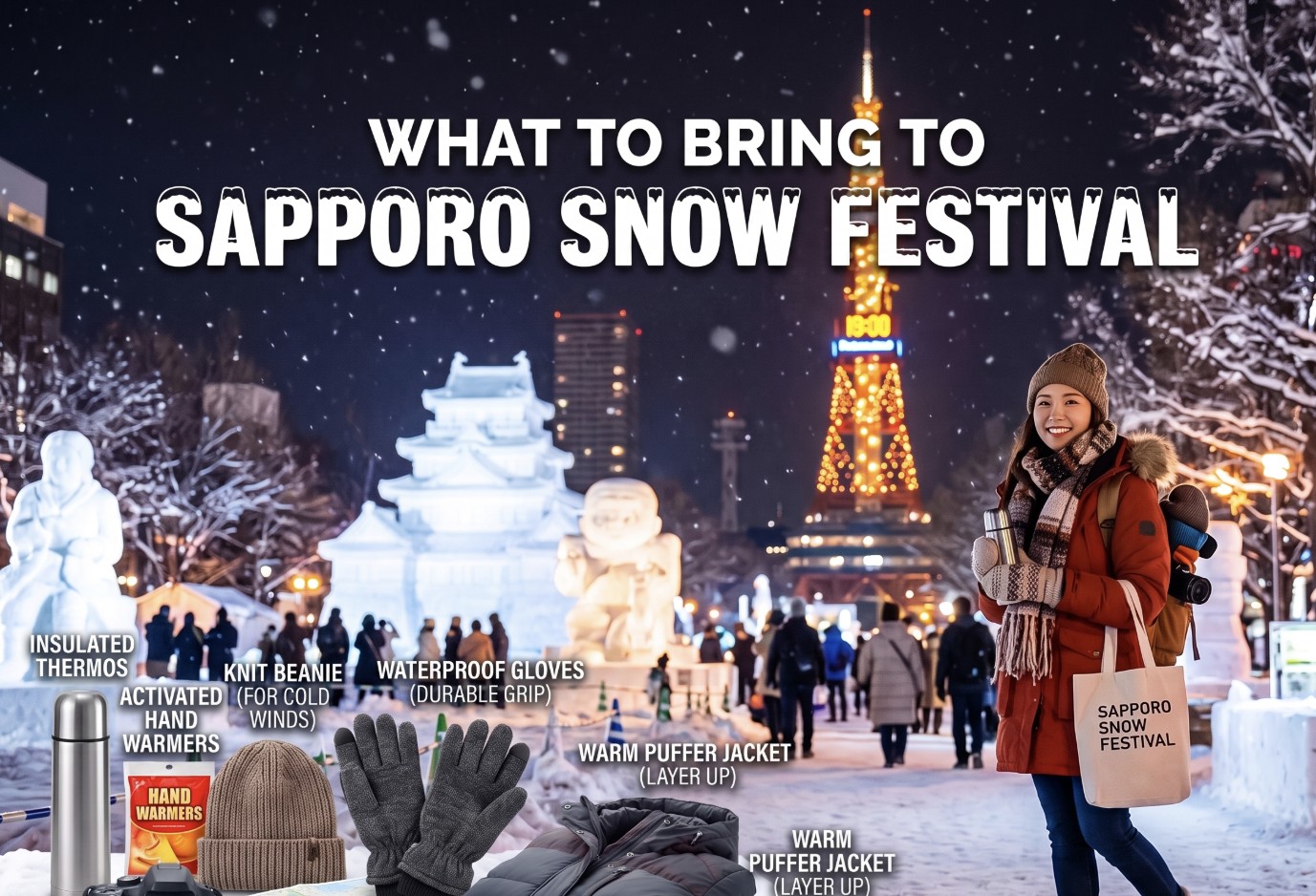
If you are wondering what to bring to the Sapporo Snow Festival in 2027, the short answer is simple: pack waterproof boots with serious grip, proper thermal layers, disposable kairo warmers and a cold-proof power bank before you think about fashion. The 2027 Sapporo Snow Festival (さっぽろ雪まつり) is scheduled for Thursday 4 February to Thursday 11 February 2027, and the festival takes place across the Odori Site (大通会場), Susukino Site (すすきの会場) and Tsudome Site (つどーむ会場 / コミュニティドームつどーむ).
February is one of the coldest times of year in Sapporo (札幌), and official winter guidance highlights icy roads, fall-prevention measures and the need for proper cold-weather clothing. In practical terms, that means you should pack as if you will be outdoors for several hours at around freezing by day and well below freezing after dark, especially if you plan to visit Susukino (すすきの) at night.
2027 Festival Dates and Sites
The latest official event information confirms that the 2027 Sapporo Snow Festival runs from 4–11 February 2027. The three main venues are:
- Odori Site (大通会場) – the main site in Odori Park (大通公園), stretching roughly from Nishi 1-chome (西1丁目) to Nishi 12-chome (西12丁目), with large-scale snow sculptures and evening illuminations.
- Susukino Site (すすきの会場) – the nightlife district venue along Ekimae-dori (駅前通), around Minami 4-jo-dori (南4条通) to Minami 7-jo-dori (南7条通), known for ice sculptures and night viewing.
- Tsudome Site (つどーむ会場 / コミュニティドームつどーむ) – the family-oriented snow activity venue in Higashi-ku (東区), with snow slides and indoor/outdoor play zones.
The best official English planning page is Sapporo Travel’s event page, while the organiser site at snowfes.com provides Japanese-language details, including access, winter clothing notes and safety information. For broader trip context, connect this post to Japan Winter Travel: Weather, Regions and What to Expect.
Quick Packing Table
| Category | What to Bring | Why It Matters |
|---|---|---|
| Footwear | Waterproof boots, removable ice cleats, thermal socks | Icy pavements are one of the biggest practical hazards during the festival. |
| Outerwear | Down coat or insulated winter jacket | Warm outerwear is essential for sub-zero conditions and long outdoor sessions. |
| Base Layers | Thermal top and leggings | Layering is essential for several hours outside in February. |
| Accessories | Touchscreen gloves, knit hat, neck gaiter | Hands, ears and face get cold first during night viewing at Odori and Susukino. |
| Heat Management | Kairo (カイロ) body and hand warmers | Useful for long hours outdoors in real Hokkaido winter conditions. |
| Tech | Power bank, spare camera battery, eSIM or pocket Wi-Fi | Cold weather drains batteries faster, and mobile data helps with maps and transport. |
| Transport & Admin | Passport, Visit Japan Web QR, IC card, cash | These speed up airport procedures, subway use and food stall purchases. |
| Comfort Extras | Lip balm, moisturiser, sunglasses, thermos | Winter air is dry and snow glare can be surprisingly strong. |
For a wider seasonal checklist beyond Hokkaido, add an internal link here to Japan Packing List: What to Pack by Season.
Klook.com1. Waterproof Boots With Grip
If you pack only one item correctly, make it your footwear. The official festival website specifically includes guidance on walking on frozen roads and reducing the risk of falls on snowy surfaces, which tells you exactly how serious the ice problem is in Sapporo winter. Trainers and smooth-soled fashion boots are simply not good enough.
- Choose waterproof insulated boots with a deep tread.
- Bring or buy removable anti-slip ice cleats (滑り止め) if your sole grip is not strong enough.
- Pack at least three pairs of thermal socks, ideally merino or synthetic rather than cotton.
Visitors usually move between JR Sapporo Station (札幌駅), Odori Station (大通駅) and Susukino Station (すすきの駅), so your footwear needs to handle station entrances, slushy crossings and icy pavement rather than deep powder snow. This is also a good internal link point for Best 7-Day Japan Bullet Train Itinerary (Scenic Routes) if you want to tie footwear choices into a wider winter rail trip.
2. Layer Properly for February
Official winter guidance for Sapporo emphasises warm clothing, and practical clothing advice for the city consistently recommends thermal underwear, warm middle layers, down outerwear, gloves, scarves and non-slip boots. A good system for the 2027 festival looks like this:
- Base layer (肌着) – thermal top and leggings.
- Mid layer – fleece, wool jumper or insulated hoodie.
- Outer layer – down coat or insulated jacket with hood.
- Lower body – thermal leggings with winter trousers or lined trousers on top.
This is especially important if you want to stay out after sunset in Susukino (すすきの), when standing still for photos makes the cold feel sharper than the thermometer suggests. You can naturally connect this section to Japan Winter Travel for readers planning multi-city trips.
3. Gloves, Hat and Neck Warmer
Your hands, ears and neck are usually the first places to feel uncomfortable in Hokkaido winter, so do not treat accessories as optional. Bring touchscreen gloves, a knit hat covering the ears, and a neck gaiter or scarf you can pull up when the wind increases.
4. Bring Kairo (カイロ) Warmers
Kairo are one of the easiest winter wins in Japan. The official winter-clothing guidance linked from the Sapporo festival ecosystem encourages practical warming strategies for long outdoor exposure, and disposable hand and body warmers are standard winter purchases across Japan.
- 貼るカイロ – adhesive warmers for your lower back or stomach.
- 貼らないカイロ – pocket warmers for hands and coat pockets.
They are widely sold in convenience stores and drugstores, so you do not need to pack large quantities from home. This section can also link internally to Konbini Snacks Guide, especially if you add a sentence about hot bottled drinks and winter convenience-store essentials.
5. Cold-Proof Your Tech
Your phone is your map, translator, camera and train helper, but batteries drain faster in cold weather. Pack a 10,000–20,000mAh power bank, a short charging cable, and a spare camera battery if you are shooting with a dedicated camera.
For data, arrange an eSIM or pocket Wi-Fi before arrival so you can navigate Sapporo immediately.
Click here to explore the eSim option on Trip.com.
Click here to explore the pocket Wi-Fi option on Klook.
Add another internal link here to Top 10 Best Travel Apps for Japan.
Klook.com6. Documents, IC Card and Cash
Before flying, complete your arrival details through Visit Japan Web so you have your immigration and customs QR codes ready. Then make sure you pack:
- Passport.
- Visit Japan Web QR screenshots.
- IC card or mobile IC setup for transport.
- Cash in small yen notes and coins.
Odori Station (大通駅) is served by the Namboku Line (南北線), Tozai Line (東西線) and Toho Line (東豊線), while Susukino Station (すすきの駅) is on the Namboku Line. Tsudome is accessed from Sakaemachi Station (栄町駅) on the Toho Line, followed by a walk or shuttle arrangement depending on the year.
This is the ideal place to add internal links to Visit Japan Web Step-by-Step Guide and Tokyo Transportation Guide.
7. Pack for Access and Arrival
The official festival site includes access guidance from both JR Sapporo Station (JR札幌駅) and New Chitose Airport (新千歳空港). In practice, most overseas travellers reach Sapporo via Tokyo or a direct connection into New Chitose, then continue by JR into central Sapporo.
The JR Rapid Airport service is the standard rail link between New Chitose Airport and Sapporo Station, and it is heavily used during winter event periods. That is why you should pack a manageable day bag rather than rely on awkward large luggage for festival-day movement.
Add internal links here to Narita Airport to Tokyo Transfer Guide, Haneda Airport to Tokyo, and How to Plan a Trip to Japan.
8. Safety and Weather Preparation
The official Japanese festival site specifically provides advice on avoiding falls on icy roads and notes that some anti-slip support items are available for visitors. For live weather and safety updates, the most authoritative resource is the Japan Meteorological Agency, while broader travel guidance is available via JNTO and Japan Travel.
This is a strong cluster point for internal safety links:
- Essential Earthquake Apps for Japan
- Japan Emergency Number
- Japanese Phrases for Emergency and Safety
- What to Do in an Earthquake in Japan
What Not to Bring
- Smooth-soled fashion boots.
- Multiple pairs of jeans as your main lower-body option.
- Bulky umbrellas that are awkward in crowded festival areas.
- Heavy camera kits you do not truly need.
- Overly stylish but impractical coats with poor insulation or water resistance.
This section can naturally support an internal link to Japan Travel Budget: Real Costs & Saving Tips, especially if you frame smart packing as a baggage-cost and comfort-saving strategy.
One-Day Festival Packing Checklist
- Wear: thermal base layer, fleece or wool mid layer, down coat, thermal leggings, winter trousers, waterproof boots, hat, scarf or neck gaiter, gloves.
- Carry: power bank, phone cable, spare battery, sunglasses, lip balm, moisturiser, tissues, cash, IC card, passport copy, kairo warmers.
- Optional extras: thermos, compact tote bag, extra socks, camera cloth.
For your full Japan-wide checklist, connect this section to Japan Packing List: What to Pack by Season.
Frequently Asked Questions
- When is the Sapporo Snow Festival 2027? The 2027 festival is scheduled from 4–11 February 2027 across the Odori, Susukino and Tsudome sites.
- What should I wear to Sapporo Snow Festival at night? Wear thermal base layers, a fleece or wool mid layer, a down coat, insulated boots, gloves, a warm hat and a scarf or neck gaiter, because night-time conditions are colder and you are often standing still outdoors.
- Do I need special shoes for the Sapporo Snow Festival? Yes, waterproof non-slip boots are strongly recommended, and the official site even includes fall-prevention guidance for walking on icy roads.
- Can I buy winter gear in Sapporo if I forget something? Yes, central Sapporo has plenty of shops and convenience stores selling warm accessories and winter basics, especially around station areas and underground shopping zones.