Every souvenir shelf in Hokkaido seems to carry the same pale blue box, and there is a reason for that. Shiroi Koibito (白い恋人, shiroi koibito, literally “white lover”) is Japan’s best-known white chocolate biscuit. Shiroi Koibito made in Sapporo since 1976, and it is also the reason thousands of travellers detour to a chocolate-themed park in the city’s Nishi Ward every year. This guide covers what the Shiroi Koibito biscuit actually is, why it became a national phenomenon, and everything you need to plan a visit to Shiroi Koibito Park (白い恋人パーク, Shiroi Koibito Pāku), including current ticket prices, opening hours, and the fastest routes from central Sapporo.
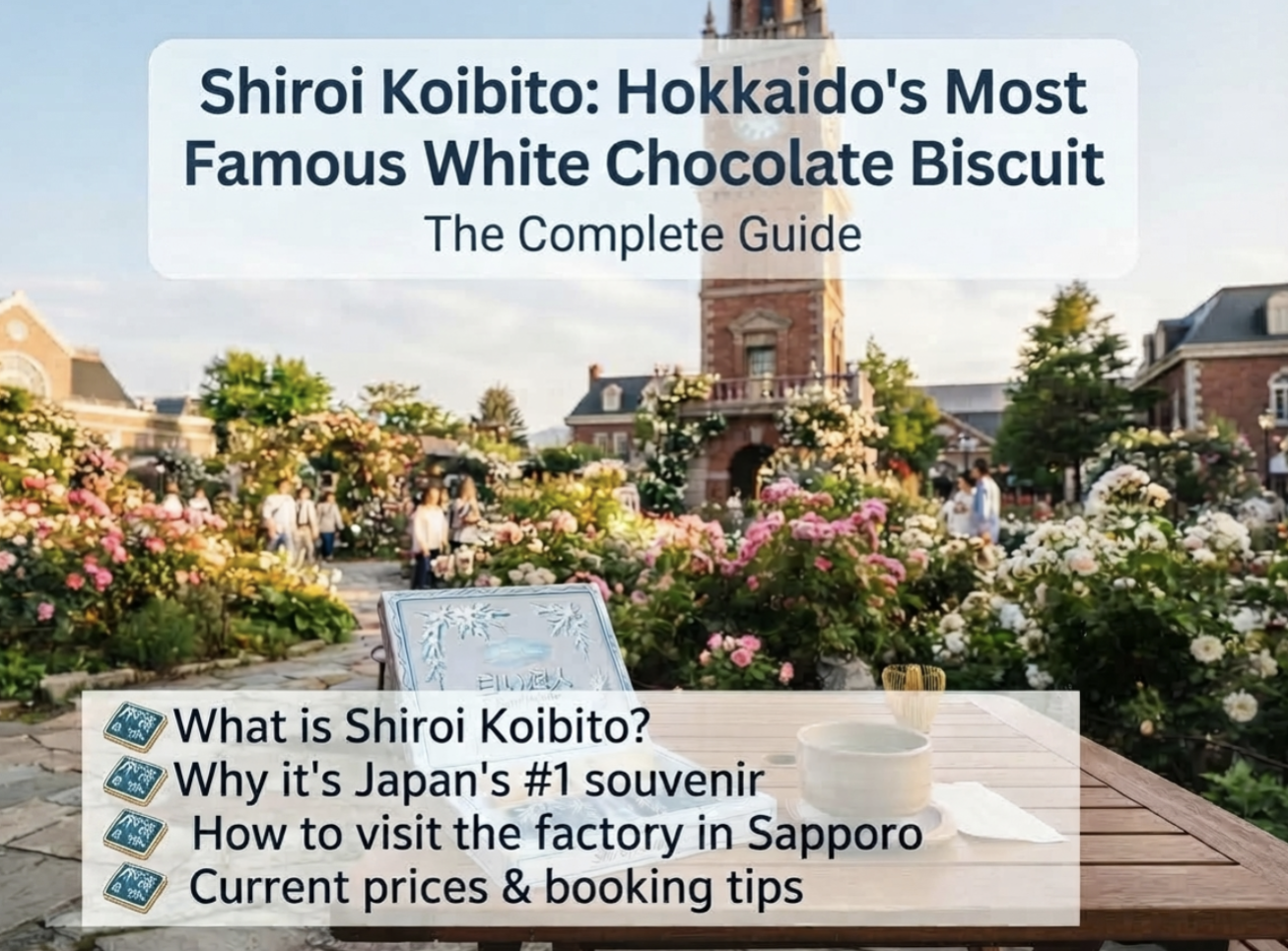
What Is Shiroi Koibito? (白い恋人とは)
Shiroi Koibito is manufactured by ISHIYA Co., Ltd. (石屋製菓, Ishiya Seika), a Sapporo confectionery house founded in 1947 by Yukiyasu Ishimizu as a small starch-processing and hard-candy business in what is now Sapporo’s Kita Ward. Under a difficult market in the 1960s, when major national confectioners began moving into Hokkaido, the company’s second-generation president, Isao Ishimizu, made the decision to abandon cheap sweets entirely and shift towards premium Western-style confectionery made with quality Hokkaido dairy and wheat. That change of direction produced Shiroi Koibito in December 1976.
The biscuit itself is simple in construction but precise in execution: two thin, crisp langue de chat cookies, known in Japanese as rangu do sha (ラング・ド・シャ, literally “cat’s tongue” in French), enclosing a thin sheet of chocolate. There are two standard varieties, Shiroi Koibito White (white chocolate filling) and Shiroi Koibito Black, sometimes labelled Milk (milk chocolate filling), and the outer box is printed in white and pale blue with an illustration of Mount Rishiri on Rishiri Island, off Hokkaido’s northern coast. One biscuit runs to roughly 57 kilocalories, and the standard shelf life is around 180 days from production, which is long enough to survive the trip home in a suitcase.

The Story Behind the Name of Shiroi Koibito
The name – Shiroi Koibito – has a genuinely charming origin, and ISHIYA still prints the story on the back of every box. Isao Ishimizu was walking home from a day of cross-country skiing one December evening when snow began to fall, and he remarked, almost without thinking, that “the white lovers are falling.” Staff working on the new premium biscuit line needed a name that matched its delicate, wintry character, and that offhand comment became it. The pale colour of the white chocolate filling was also chosen deliberately to echo Hokkaido’s snow-covered winters, which is part of why the product reads as unmistakably regional rather than generic.

Why Shiroi Koibito Became Japan’s Most Famous White Chocolate Biscuit
- Regional exclusivity built desirability. For decades ISHIYA sold Shiroi Koibito almost exclusively within Hokkaido, which turned it into a must-bring-back omiyage (お土産, souvenir gift) rather than something available everywhere.
- International recognition. The biscuit won a gold medal at the Monde Selection quality awards in 1986, a credential ISHIYA still uses in its marketing.
- Genuine scale. Annual sales sit at roughly 200 million biscuits, worth an estimated ¥10 billion, making Shiroi Koibito the second best-selling single souvenir item in Japan by unit sales, behind only Akafuku mochi (赤福餅, from Mie Prefecture).
- Trade recognition. A Japanese confectionery trade journal survey named Shiroi Koibito the definitive “souvenir that represents the 20th century,” placing it well ahead of the second-place finisher, karashi mentaiko (辛子明太子, spicy cod roe).
- Visual identity. The pale white chocolate colour, the blue-and-white box, and the Mount Rishiri illustration are instantly recognisable across Japanese airports, department stores, and konbini souvenir corners.
The brand’s history is not spotless. On 14 August 2007, ISHIYA was found to have been falsifying the shōmi kigen (賞味期限, best-before date) on Shiroi Koibito packaging, in some cases extending it by up to a month, a practice that had reportedly been going on for over a decade. The company was forced to suspend both production and sales under Japan’s Food Hygiene Law and JAS Law. President Shunpei Shimada held a press conference on 22 October 2007 to announce a recovery plan, production resumed on 15 November 2007, and sales resumed a week later on 22 November, roughly 100 days after the scandal broke. ISHIYA responded by printing individual best-before dates on every wrapped biscuit rather than only on the outer box, tightening quality inspection, and refining the chocolate recipe itself. Sales and public trust have both recovered fully in the years since, and the incident is now mostly remembered as a case study in Japanese food-safety compliance rather than a mark against the product.

How Shiroi Koibito Compares to Other Hokkaido Sweets
| Biscuit / Sweet | Maker | Format | Best For |
|---|---|---|---|
| Shiroi Koibito (白い恋人) | ISHIYA | Langue de chat with white or milk chocolate filling | Classic Hokkaido souvenir with the widest availability nationwide |
| Royce’ Chocolate Potato Chips | Royce’ Confect | Potato crisps coated in chocolate | Novelty gift for fans of salty-sweet combinations |
| Kinotoya Baked Chocolate | Kinotoya | Baked chocolate cookie sandwich | Convenient last-minute buy at Sapporo Station |
| LeTAO Double Fromage | LeTAO | Layered rare and baked cheesecake | A chilled, fresh option specific to Otaru |
Why Is Shiroi Koibito So Popular?
The popularity comes down to sensory balance and cultural fit rather than novelty. The langue de chat wafer is thin and crisp rather than heavy, so the chocolate filling never feels cloying, and the biscuit works equally well with green tea or coffee. Pricing also plays a part: a 12-piece box currently retails at around ¥1,036 to ¥1,144 (tax included) through ISHIYA’s own shops and official online store, with smaller 9-piece boxes from about ¥777 and larger 24-piece assorted boxes (12 white, 12 milk) from roughly ¥2,073 to ¥2,289. That range makes it an easy, low-risk choice for okubarigashi (お配り菓子), individually wrapped sweets bought specifically to hand round an office or extended family rather than kept for yourself. ISHIYA also keeps the product line fresh with spin-offs, including a baked cookie version, ice cream, and seasonal sakura-themed editions, which gives repeat buyers a reason to keep checking the shelves.
If you are building out a wider Hokkaido shopping list, it is worth cross-referencing a dedicated Japan souvenir shopping guide before you fly, since airport departure lounges tend to have shorter opening hours than city-centre stores.
Why Visit Shiroi Koibito Park (白い恋人パーク)?
Shiroi Koibito Park is ISHIYA’s factory and visitor complex in Sapporo’s Nishi Ward, built around the working Shiroi Koibito production line. It has grown from a simple factory tour into one of Sapporo’s most-bookmarked family attractions, and it rewards a half-day visit rather than a quick stop.
- Watch the real Shiroi Koibito production line through large viewing windows on the factory floor, alongside a chocolate history exhibition covering cacao’s journey from bean to bar.
- Book a hands-on session at the in-house Sweets Workshop DREAM KITCHEN, where visitors decorate and take home their own biscuits.
- Wander the European-village grounds: a red-brick clock tower, an English rose garden with around 200 varieties in bloom through summer, and Tudor-style architecture.
- Visit during the free seasonal “Sweet Illumination,” which runs from mid-November to the end of March and is lit nightly through the early evening.
- Combine the visit with a look at the adjacent Miyanosawa Shiroi Koibito Soccer Field (2 Jo 3 Chome, Nishi Ward), the dedicated training ground of Hokkaido Consadole Sapporo, currently competing in Japan’s J2 League; the natural-grass pitch has an under-turf heating system and stand seating for around 3,000 spectators.
For deeper background on visiting Hokkaido safely and comfortably outside the park itself, it is worth reading a broader Hokkaido winter travel guide, and cross-checking the Hokkaido Official Tourism Portal and the Japan Meteorological Agency for seasonal weather and any earthquake advisories, particularly if you are travelling between December and March.
Klook.comHow to Book: Official Site, Klook or Trip.com
You can buy tickets on arrival at the Ticket Center, but booking ahead avoids queueing during the winter illumination season. ISHIYA use Trip.com as their official ticket site sells direct admission e-ticket at a discounted price. . If you want to join the paid workshop, you need to go to the Japanese page and reserve the workshop slots. Klook also has a half-day guided tours that pair the park with Okurayama.
Address, Opening Hours and Getting There
Shiroi Koibito Park is located at 2 Chome-11-36 Miyanosawa 2 Jo, Nishi Ward, Sapporo, Hokkaido 063-0052, with a general enquiry line on +81-11-666-1481. The Ticket Center and paid factory area operate from 10:00 to 17:30, with last admission at 16:30. There are no fixed closing days, though hours can shift slightly around New Year; always check the official visitor information page before you travel.
- By subway: Take the Tōzai Line (東西線) from Odori Station to Miyanosawa Station (宮の沢駅), the line’s western terminus, a journey of around 16 minutes, then walk roughly 7 minutes to the park entrance.
- By bus: Chuo Bus or JR Hokkaido Bus services running towards Otaru from Sapporo Station’s bus terminal stop at Nishimachi Kita 20-chome (西町北20丁目), a 5 to 7-minute walk from the park.
- By car: The park is roughly a 25-minute drive from central Sapporo Station. On-site paid parking is available; check the park’s official facilities page for current rates before you arrive.

If you are arriving from further afield, it helps to plan the whole journey rather than just the last mile. Check current train and transfer conditions through JR Hokkaido Railway Company’s official site, confirm entry procedures using the Visit Japan Web pre-arrival portal, and see a wider Tokyo to Hokkaido transport guide if you are connecting through Tokyo. Sapporo-specific event calendars are best verified through the Sapporo City Official Tourism Site, and for general Japan travel planning and entry requirements, see the Japan National Tourism Organization.
Shiroi Koibito Park Tickets: Prices and Booking Options
The paid Shiroikoibito Factory area reopened on Thursday, 30 July 2026 following renovation work, and the table below reflects the pricing that has applied since that reopening, as published on ISHIYA’s official visitor information page.
| Ticket Type | General Price | Group Price (20+ people) |
|---|---|---|
| Adults (16 years and older) | ¥1,200 | ¥900 |
| Children (4 years old to junior high school age) | ¥600 | ¥500 |
| Children under 3 years old | Free | Free |
All prices include tax. A ¥200 discount applies for guests presenting a Physical Disability Certificate, Rehabilitation Certificate, or Mental Disability and Welfare Certificate, plus one accompanying carer (Mirairo ID accepted); this cannot be combined with other discounts. Entry to the free zones, including the garden, clock tower plaza, and main shop, remains free year-round.
Best Time to Visit
Summer (June to August) is best for the rose garden, when around 200 varieties are in bloom around the clock tower plaza. Winter (mid-November to end of March) is best for the free evening illumination, though this is also when Sapporo’s Snow Festival (さっぽろ雪まつり, Sapporo Yuki Matsuri) crowds push up demand for accommodation, so it is worth checking a general Sapporo trip-planning guide alongside a Hokkaido itinerary guide before locking in dates. Shoulder months (May and October) offer smaller crowds and mild walking weather if your priority is the factory tour rather than the gardens.

Frequently Asked Questions
- What is the most famous white chocolate biscuit in Japan? Shiroi Koibito, made by ISHIYA in Sapporo since December 1976, is widely regarded as Japan’s most famous white chocolate biscuit and sits among the country’s top two best-selling single souvenir items by unit sales.
- Is Shiroi Koibito only sold in Hokkaido? It was originally sold exclusively within Hokkaido, and most stock is still concentrated there, though it is now also available at select duty-free counters at major Japanese airports for departing travellers.
- How much does Shiroi Koibito Park cost to enter? Following the 30 July 2026 reopening of the paid factory area, general adult admission is ¥1,200, children aged 4 to junior high school pay ¥600, and children under 3 enter free. The garden and shop areas remain free to enter.
- Do I need to book Shiroi Koibito Park tickets in advance? It is not strictly required, but booking through the official ticket site, Klook, or Trip.com beforehand is recommended during the winter illumination period from mid-November to the end of March, when queues form at the ticket counter.
- How do I get to Shiroi Koibito Park from Sapporo Station? Take the Namboku Line one stop to Odori Station (about 2 minutes), transfer to the Tōzai Line, and ride it to its Miyanosawa terminus (around 16 minutes), then walk about 7 minutes to the park entrance.