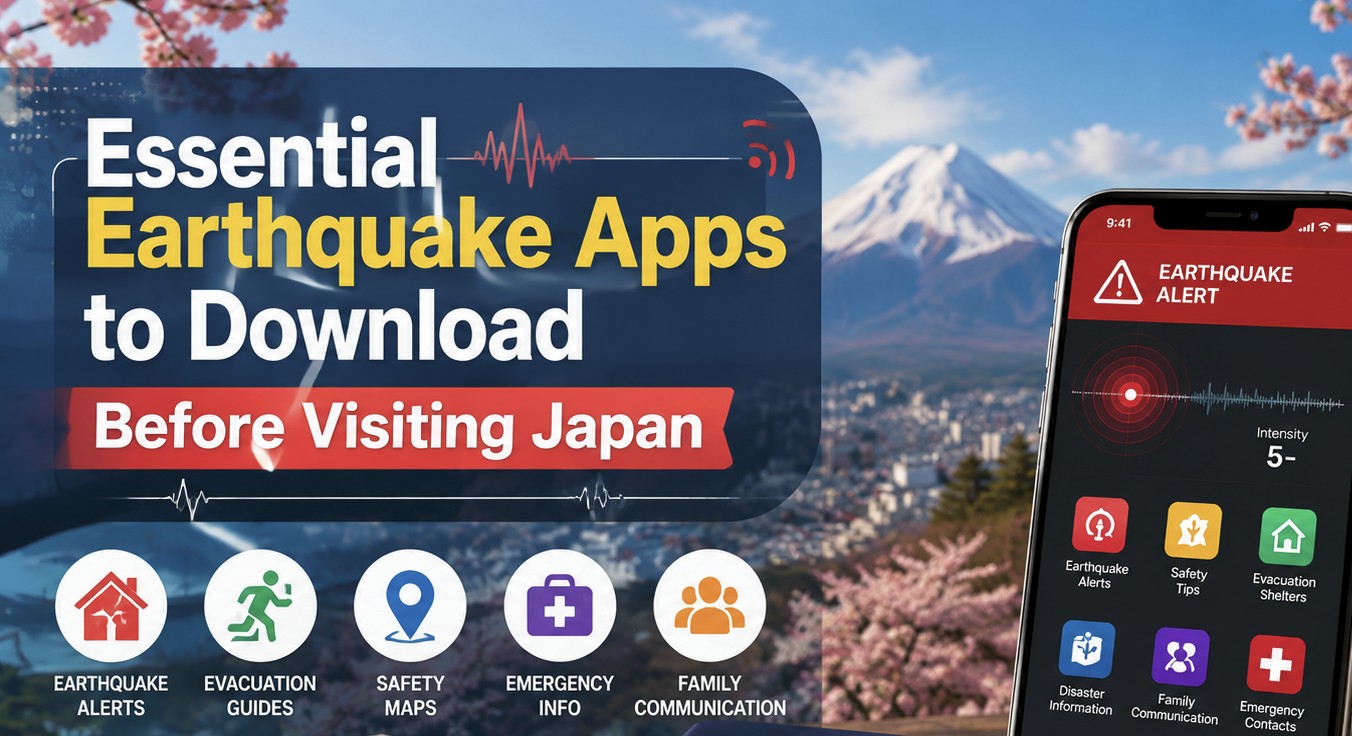
Before travelling to Japan, download the official Safety Tips app, save the JNTO Japan Visitor Hotline and bookmark Japan Safe Travel Information, NHK WORLD-JAPAN and the Japan Meteorological Agency. These tools provide multilingual earthquake, tsunami and severe-weather updates, helping visitors access reliable information quickly. In an emergency, however, always follow instructions from local authorities, emergency services, accommodation staff and transport operators.
Disclaimer: This article is intended as general travel guidance only and may not reflect a live emergency situation. In any emergency, always follow instructions issued by local authorities, emergency services, accommodation staff, transport operators and official Japanese warning systems. Do not rely on an app or this article as a substitute for immediate safety action.
Japan is an exceptionally organised destination for independent travel, but earthquakes, typhoons, volcanic activity and heavy rain are all natural hazards visitors should understand before arrival. Most trips are completely unaffected by major disruption. Still, a few minutes of preparation before you fly can make a real difference if you need emergency information while staying in 東京 (Tokyo), 京都 (Kyoto), 大阪 (Osaka), 札幌 (Sapporo), 福岡 (Fukuoka), 沖縄 (Okinawa) or a more remote part of the country.
The aim is not to fill your phone with every earthquake app available. Instead, download or bookmark a small number of reliable, visitor-friendly sources. You should also ensure your phone can receive notifications, has mobile data available and can access important information if hotel Wi-Fi becomes unavailable.
The most important app: Safety Tips
The first app every international visitor should download is Safety Tips. It is designed for foreign tourists and residents in Japan, and is supervised by the Japan Tourism Agency. The app provides push notifications for Earthquake Early Warnings, tsunami warnings, weather warnings, volcanic warnings, heat-illness warnings and civil-protection information.
Safety Tips is particularly useful because it is built with overseas visitors in mind. It supports English, Japanese, Korean, Traditional Chinese, Simplified Chinese, Vietnamese, Spanish, Portuguese, Thai, Indonesian, Tagalog, Nepali, Khmer, Burmese and Mongolian. For travellers who do not read Japanese, this multilingual support is the main reason it should be your default disaster-information app.
It also includes an evacuation flowchart, useful emergency phrases and links to further information. Download it before leaving your country, allow notifications and check that your phone is not set to suppress important alerts. Do not wait until an earthquake has already occurred; mobile networks and app stores may be harder to use during a widespread disruption.
Safety Tips should be treated as an information tool, not a substitute for immediate safety action. If you are indoors when shaking begins, protect your head and neck and follow staff instructions. If you are near the coast after strong shaking, or weak but long-lasting shaking, move to higher ground or inland as soon as it is safe to do so. Do not wait for an app notification before taking urgent action to protect yourself.
NHK WORLD-JAPAN: English-language news and alerts
Download the NHK WORLD-JAPAN app as a second source of information. NHK is Japan’s public broadcaster, and its international service provides English-language news alongside other language options. JNTO lists NHK WORLD-JAPAN among the recommended resources for visitors during significant natural disasters.
The app and website can help you understand the wider situation after an earthquake, tsunami warning, typhoon or major transport disruption. This matters when you are trying to work out whether an incident is local to one prefecture, affecting a railway line or causing broader disruption to airports, accommodation and intercity travel.
NHK WORLD-JAPAN provides earthquake and tsunami notifications in selected languages, including English. It is especially useful once you are safe and need clear reporting, updates and practical context. During immediate shaking, put your safety first rather than looking at your phone.
Here is the link: https://www3.nhk.or.jp/nhkworld/en/app/
Japan Safe Travel Information: bookmark the official website
Not every essential emergency resource is an app. Japan Safe Travel Information is an official JNTO website designed to provide foreign visitors with disaster and safety information. Bookmark it in your browser before departure and add it to your home screen so it is easy to find when you need it.
The site provides information on earthquakes reported at JMA seismic intensity 5 Lower or stronger, as well as tsunami warnings and advisories, specified volcanic warnings, emergency weather warnings and civil-protection information. It also provides access to the 24-hour JNTO Japan Visitor Hotline for visitors needing assistance during illness, disasters and other emergencies.
Japan Safe Travel Information is a useful central reference point after you are safely out of immediate danger. It should not be used as a reason to delay evacuation. If you are near the coast and experience strong shaking, or weak but long-lasting shaking, move to higher ground or inland as soon as it is safe to do so and follow evacuation signage or local announcements.
Japan Meteorological Agency: the official source for warnings
The Japan Meteorological Agency, usually shortened to JMA, is Japan’s official national authority for issuing Earthquake Early Warnings, tsunami warnings and advisories, weather warnings and volcanic information. Its official English-language webpages are useful resources to bookmark before your trip.
JMA information is particularly important for travellers visiting coastal areas, islands or regions affected by severe weather. Its tsunami pages show whether a Major Tsunami Warning, Tsunami Warning or Advisory is in effect, while its earthquake pages provide the latest reported seismic information.
Remember that an Earthquake Early Warning may give only seconds of notice, or no useful notice if you are close to the epicentre. If you receive one, do not spend time searching online for more detail. Protect yourself immediately. If a tsunami warning is issued, or if you are on the coast after strong shaking or weak but long-lasting shaking, evacuate to higher ground or inland. Remain in a safe location until authorities cancel the tsunami warning.
Which official tools should you use?
| Tool | Best use | Why it matters for visitors |
|---|---|---|
| Safety Tips app | Multilingual push alerts and visitor-focused emergency guidance. | Designed for overseas travellers, with alerts for earthquakes, tsunamis, weather, volcanoes and civil-protection information. |
| NHK WORLD-JAPAN app | English-language news and disaster updates. | Useful for understanding the broader impact of a major event once you are safe. |
| Japan Safe Travel Information | Official visitor safety website and travel-emergency support details. | Provides disaster information and access to the JNTO Japan Visitor Hotline. |
| Japan Meteorological Agency website | Official earthquake, tsunami, weather and volcanic warnings. | The primary source behind Japan’s official meteorological and seismic warnings. |
Set your phone up before you fly
Downloading an app is only the first step. Before you leave for Japan, check that notifications are enabled, location access is allowed where needed and battery-saving settings are not blocking important alerts. If you use an iPhone or Android phone, review the emergency-notification settings in advance rather than assuming everything will work automatically overseas.
- Download Safety Tips and NHK WORLD-JAPAN while you still have reliable home Wi-Fi.
- Bookmark Japan Safe Travel Information and the English-language JMA warning pages.
- Allow push notifications for Safety Tips and NHK WORLD-JAPAN.
- Save your accommodation name, address and telephone number offline.
- Keep a power bank in your day bag and charge it each evening.
- Save emergency contacts in your phone before departure.
- Download offline maps for the cities and regions on your itinerary.
Mobile data is helpful for receiving alerts, reading maps and contacting accommodation. A Japanese eSIM from a provider such as Airalo can give you data from arrival without needing to search for public Wi-Fi. However, mobile data should support your travel safety plan, not replace basic preparation. Keep some yen cash, know your hotel address and carry a small power bank.
Emergency numbers and support for tourists
Save these numbers before travelling. For an immediate emergency involving police, crime or a traffic accident, dial 110. For an ambulance or fire service, dial 119. These are the numbers to use where there is immediate danger, serious illness, injury or fire.
For visitor support, save the JNTO Japan Visitor Hotline: 050-3816-2787 when calling from within Japan. From overseas, call +81-50-3816-2787. It operates 24 hours a day, 365 days a year, and provides support in English, Chinese, Korean and Japanese. It can help overseas visitors with general travel information and assistance in emergencies, including natural disasters. It is not a replacement for calling 110 or 119 where urgent emergency help is needed.
If a major disaster affects your itinerary, your hotel, airline, railway company, tour provider and travel insurer may all issue separate instructions. Follow the guidance that applies directly to your location. For example, a railway operator’s announcement takes priority if you are on a train, while hotel staff instructions take priority if you are staying in accommodation.
How to use apps during an earthquake
Do not look at your phone while you are trying to protect yourself from an earthquake. If shaking starts, get low, cover your head and neck, hold onto something stable and move away from windows or objects that could fall. Only check notifications once the shaking has stopped and you are in a safe position.
On a train, remain seated where possible or hold a rail if standing. Do not try to force doors or leave the carriage. In a hotel, use stairs rather than lifts if an evacuation is required. Outdoors, move away from glass, signs, walls, utility poles and trees. Near the coast, strong shaking, or weak but long-lasting shaking, means you should evacuate to higher ground or inland immediately.
Apps are valuable because they can give you alerts and reliable updates, but they cannot assess the hazards directly around you. Your immediate surroundings, local announcements, emergency signage and official instructions matter most.
Official links to save
- JNTO Safety Tips for Travellers
- JNTO Staying Safe in Japan
- Japan Meteorological Agency: English-language homepage
- JMA Weather Warnings and Advisories
- NHK WORLD-JAPAN
Final checklist before your Japan trip
- Download Safety Tips and enable notifications.
- Download NHK WORLD-JAPAN for English-language news and updates.
- Bookmark Japan Safe Travel Information and the JMA warning pages.
- Save 110, 119 and the JNTO Japan Visitor Hotline: 050-3816-2787.
- Carry a charged power bank, water, medication and a small amount of yen.
- Check the emergency exit and stairwell when you arrive at each hotel or ryokan.
- Follow local authorities, emergency services, hotel staff and transport operators during any incident.
Japan is a safe and remarkably well-prepared destination, and these simple steps are about confidence rather than fear. Download the right official tools, keep your phone charged and know when to stop checking your screen and act. For more practical Japan planning guides, bookmark Inspires Plus before your trip.
Frequently Asked Questions
- What is the best official earthquake app for tourists in Japan? Safety Tips is the best starting point for international visitors. It is designed for foreign tourists and provides multilingual push notifications for Earthquake Early Warnings, tsunami warnings, weather warnings and other emergency information.
- Do I need a Japanese phone number to receive earthquake alerts in Japan? No. You can use Safety Tips and other internet-based resources through mobile data or Wi-Fi. However, reliable mobile data and enabled app notifications will make it easier to receive updates promptly.
- Should I download a third-party earthquake app as well? You may choose to, but official visitor guidance should be your priority. Download Safety Tips first, and use JNTO, NHK WORLD-JAPAN and JMA information to verify significant alerts or changing conditions.
- What should I do if I receive a tsunami warning in Japan? Follow official instructions immediately. If you are near the coast, move to higher ground or inland as soon as it is safe to do so, and remain in a safe location until authorities cancel the warning.
Disclaimer: This article is intended as general travel guidance only and may not reflect a live emergency situation. In any emergency, always follow instructions