
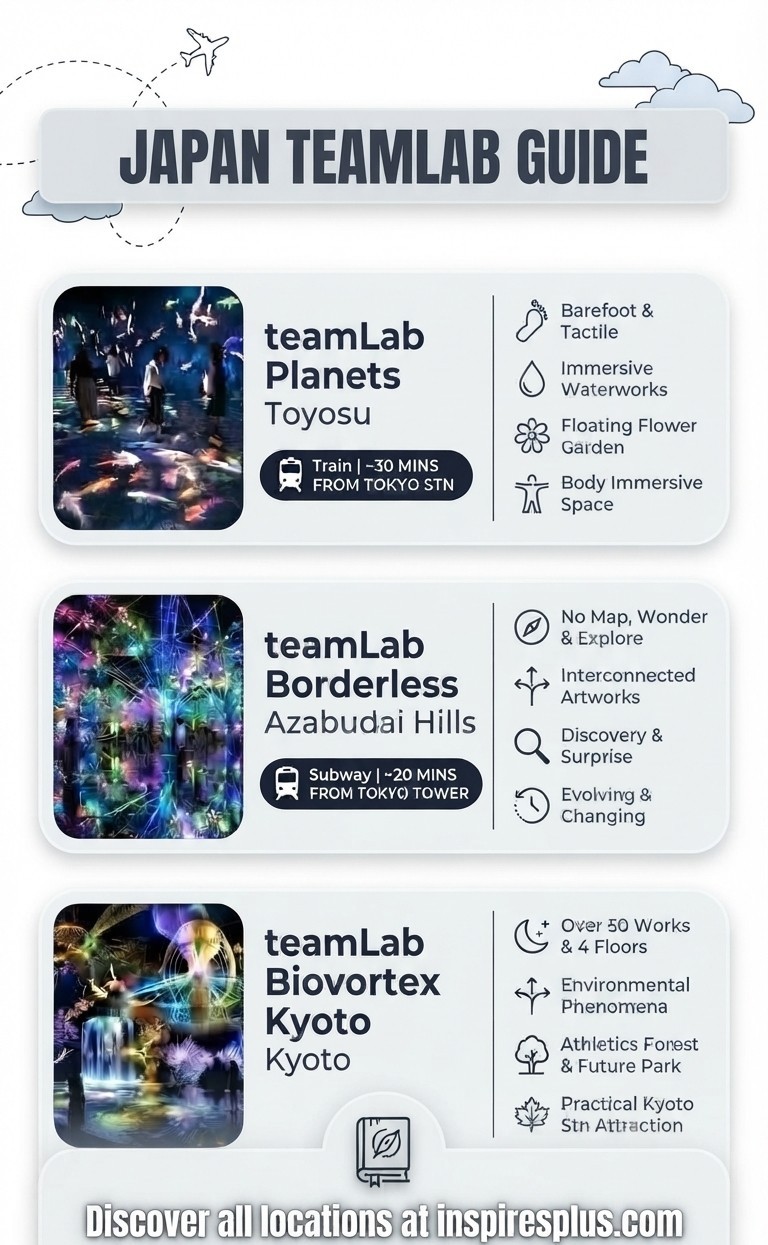
teamLab Planets, teamLab Borderless and teamLab Biovortex Kyoto are three very different immersive digital-art museums by teamLab (チームラボ, Chīmu Rabo). Planets is the barefoot water-and-garden experience in Toyosu; Borderless is the mapless, shoes-on museum at Azabudai Hills in central Tokyo; and Biovortex is the largest teamLab museum in Japan, a short walk from Kyoto Station. The best one to book depends on your route, the ages in your group and how you want to experience the art.
For most first-time Tokyo visitors, teamLab Borderless is the most practical all-round choice. Choose teamLab Planets TOKYO (チームラボプラネッツ TOKYO, Chīmu Rabo Puranettsu Tōkyō) if walking barefoot through water is the specific experience you want, and visit before its announced end-of-2027 closure. Choose teamLab Biovortex Kyoto (チームラボ バイオヴォルテックス 京都, Chīmu Rabo Baiovorutekkusu Kyōto) if you are travelling through Kyoto, want the biggest collection, or have active children who will enjoy its Athletics Forest and Future Park areas.
teamLab Planets vs Borderless vs Biovortex (2026)
| Feature | teamLab Planets TOKYO | teamLab Borderless | teamLab Biovortex Kyoto |
|---|---|---|---|
| Location | 6-1-16 Toyosu, Koto-ku, Tokyo | Azabudai Hills Garden Plaza B B1, Minato-ku, Tokyo | 21-5 Higashikujo Higashi-Iwamotocho, Minami-ku, Kyoto |
| Japanese address | 東京都江東区豊洲6-1-16 | 東京都港区麻布台1-2-4 | 京都市南区東九条東岩本町21-5 |
| Opened | 7 July 2018; scheduled to close at the end of 2027 | 9 February 2024; permanent | 7 October 2025; permanent |
| Concept | Barefoot water, light and garden works | Mapless, interconnected art world | Large-scale artworks, Athletics Forest and Future Park |
| Nearest station | Shin-Toyosu Station, 1 minute on foot | Kamiyacho Station Exit 5, 2 minutes on foot | Kyoto Station Hachijo East Gate, 7 minutes on foot |
| Published hours | Typically 8:00–22:00; check the date calendar | Typically 8:30–21:00; check the date calendar | 9:00–21:00; final entry 19:30 |
| Adult ticket | From ¥3,600; dynamic pricing | Dynamic pricing; check the official calendar | From ¥3,800; dynamic pricing |
| Ages 13–17 | ¥2,800 | ¥2,800 | ¥2,800 |
| Children aged 4–12 | ¥1,500 | ¥1,500 | ¥1,800 |
| Children aged 0–3 | Free | Free | Free |
| Flexible or Premium Pass | ¥12,000 | ¥12,000 | ¥12,000 |
| Barefoot? | Yes, for the main artwork areas | No | No; secure trainers are needed for Athletics Forest |
| Strollers | Stored before entering the artwork areas | Stored in the luggage room | Stored in the luggage room |
Ticket pricing, opening hours, individual artwork availability and closure dates change by day. Select your intended date on the official teamLab page or Klook.com before paying. Planets does not sell tickets at the entrance. Borderless and Biovortex can have limited same-day availability, but this is not a dependable plan for weekends, Japanese public holidays, cherry blossom season or autumn foliage season.
teamLab Planets TOKYO: Best for Water and Photographs

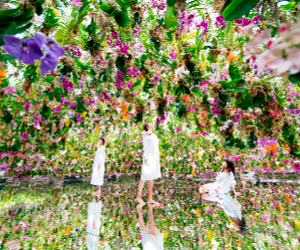
teamLab Planets TOKYO is a physical, sensory experience rather than a conventional gallery. After removing shoes and socks, visitors walk through water, soft surfaces, mirror-filled spaces and garden works. In Drawing on the Water Surface Created by the Dance of Koi and People – Infinity, digital koi respond to bodies in the water, change direction and turn into flowers when they collide. The scale and reflected light make Planets one of the most recognisable teamLab Tokyo experiences, but the water is a real practical consideration rather than a decorative detail.
The museum stands at 6-1-16 Toyosu, Koto-ku, Tokyo, written in Japanese as 東京都江東区豊洲6-1-16. The closest station is Shin-Toyosu Station (新豊洲駅, Shin-Toyosu-eki) on the Yurikamome Line (ゆりかもめ, Yurikamome), around one minute away on foot. Toyosu Station (豊洲駅, Toyosu-eki), served by the Yurakucho Line, is about 10 minutes away. This waterfront location, in the Toyosu (豊洲) district of Koto-ku (江東区), is convenient if you are staying nearby or visiting Odaiba, but less central than Borderless for a short Tokyo break.

Wear trousers that roll above the knee or shorts. Planets provides free rental shorts from XS to 6L, and visitors in skirts can borrow a wrap. The museum also has routes that allow certain works to be bypassed, but people with limited balance, a reluctance to walk through water, or a stroller should consider Borderless or Biovortex instead. Strollers are left in storage before the artwork areas, and infants need to be carried through parts of the museum. Allow around 90 to 120 minutes, plus time for photography and the post-admission dining and shop areas.
Planets publishes long hours, generally around 8:00–22:00 with final entry one hour before close, but the calendar can vary and selected weekday closures occur. It has a stated end date of the end of 2027, so it deserves priority over the two permanent venues if it is already on your wish list. For ideas that fit naturally before or after your slot, use our Tokyo travel guide.
teamLab Borderless: Best for a First Tokyo Trip

iteamLab Borderless (チームラボボーダレス, Chīmu Rabo Bōdaresu) is built around the idea of a “museum without a map”. Artworks move out of rooms, cross into other spaces and change through contact with people and other works. There is no fixed route, so visitors can revisit rooms, linger in the Forest of Resonating Lamps, search for the Infinite Crystal World or stop at EN TEA HOUSE, where the tea itself becomes part of the experience. This open structure is why Borderless is the strongest all-round teamLab museum for adults, couples and families who prefer shoes-on exploration.
Do not use old Odaiba directions. The original Borderless venue closed in 2022; the current museum opened permanently on 9 February 2024 at Azabudai Hills Garden Plaza B B1. Its Japanese street address is 東京都港区麻布台1-2-4 (1-2-4 Azabudai, Minato-ku, Tokyo). Kamiyacho Station (神谷町駅, Kamiyachō-eki) on the Hibiya Line is the easiest station: Exit 5 is around two minutes on foot. Roppongi-itchome Station (六本木一丁目駅, Roppongi-itchōme-eki) on the Namboku Line is around six minutes away. Both have an underground route to the venue.

Borderless generally operates around 8:30–21:00, with final entry an hour before closing, although the exact opening times and selected Tuesday closures change by date. Adult rates use dynamic pricing, while standard youth tickets for ages 13–17 are ¥2,800 and children aged 4–12 are ¥1,500. Children aged three and under enter free. A Flexible Pass, valid for any entry time on a selected date, costs ¥12,000. If on-site stock remains, a same-day Borderless ticket costs ¥200 more than the corresponding online ticket.
Borderless is easier than Planets for visitors who do not want wet floors or bare feet, but it is still an immersive environment. Expect dark areas, flashing light, sound, aroma effects and occasional uneven surfaces. Strollers are stored in the luggage room, and a few spaces have restrictions for safety or access reasons. Give yourself two to three hours, particularly if you want to revisit installations or visit EN TEA HOUSE. It fits especially well with a central Tokyo itinerary and accommodation around Roppongi, Toranomon or Tokyo Tower.
teamLab Biovortex Kyoto: Best for Scale and Active Families

teamLab Biovortex Kyoto opened on 7 October 2025 and is teamLab’s largest museum in Japan by floor area, extending over 10,000 square metres across four floors with more than 50 works. It is not simply a Kyoto version of Borderless. Its Environmental Phenomena area includes works such as Morphing Continuum, Massless Amorphous Sculpture and Massless Suns and Dark Suns; the Athletics Forest brings climbing, balancing and bouncing elements; and Future Park includes collaborative works such as Sketch Ocean. That variety makes Biovortex a substantial rainy-day activity and one of the most practical Kyoto Station attractions.
The museum is at 21-5 Higashikujo Higashi-Iwamotocho, Minami-ku, Kyoto, written 京都市南区東九条東岩本町21-5. It is a seven-minute walk from the Hachijo East Gate (八条東口, Hachijō Higashiguchi) at JR Kyoto Station (京都駅, Kyōto-eki). Shichijo Station (七条駅, Shichijō-eki) on the Keihan Main Line is around 11 minutes away. There is no visitor car or motorcycle parking, which is another reason to arrive on foot, by rail or by taxi.

Published hours are 9:00–21:00, with final entry at 19:30. The child rate is ¥1,800 for ages 4–12, higher than the child rate at the Tokyo venues; ages 13–17 pay ¥2,800, children aged three and under enter free, and a Flexible Pass costs ¥12,000. Adult entry begins at ¥3,800 and is dynamic. The disability ticket is ¥1,900 for the visitor and one accompanying person. If an on-site ticket remains available, it costs ¥200 more than the online price. The official calendar lists irregular closure days, so do not assume the museum is open every day.
Bring secure, closed trainers if you want to use Athletics Forest. High heels, sandals, wooden clogs and unstable footwear are not allowed in that area; rental trainers are available in limited sizes, but your own footwear is the safer choice. The museum has dark areas, loud sound, flashing light, aromas, stairs and uneven surfaces. Wheelchair users can enter, but the accessibility of individual artworks differs, so confirm your needs with the museum before booking. Families should allow at least two to three hours and longer if children want to spend time in Future Park.
Biovortex is particularly easy to include on a Tokyo–Kyoto route because it is close to the Shinkansen platforms. Use this seven-day Tokyo, Kyoto and Osaka itinerary to shape a multi-city trip, and compare Kyoto Station versus Gion if you are deciding where to stay. For a rail-focused route, our Japan bullet-train itinerary explains the Tokyo–Kyoto journey in practical detail.
Klook.comPhotography, Etiquette and What to Pack
All three museums allow personal photography and video for non-commercial use, but tripods, selfie sticks and flash are generally not permitted, since the flash can wash out the projected light and disturb other visitors. Large bags, umbrellas and hard suitcases must go into a coin locker or the free cloakroom before you enter, so travel light on the day you book teamLab tickets Tokyo and Kyoto visitors rely on for their itinerary. Phones and small cameras are fine to carry, and most visitors get their best shots by arriving close to opening time, before the rooms fill up.
Dress differently for each venue. For Planets, bring a small dry bag or plastic pouch for a phone, a spare pair of socks, and clothing you do not mind getting slightly damp at the hem. For Borderless, ordinary daywear and comfortable shoes are sufficient, though avoid long, loose skirts near the mirrored floor sections unless you are happy to borrow a wrap. For Biovortex, proper trainers matter more than for the other two, particularly if you intend to use Athletics Forest, and a light layer is useful since some rooms run cooler than the Kyoto summer heat outside.
Booking Tips for Tokyo and Kyoto
Book your timed-entry ticket once your hotel and long-distance transport are fixed. Prioritise weekends, public holidays and school-break dates first. A morning ticket can leave the rest of the day free, while an evening Planets or Borderless slot can work well after sightseeing, provided you do not arrive exhausted. For a complete planning sequence covering flights, accommodation, rail travel, IC cards and Visit Japan Web, read our guide to planning a Japan trip.
Two teamLab museums are worthwhile if your itinerary includes both Tokyo and Kyoto, as the works and spatial layouts are not duplicates. However, most first-time visitors do not need all three. Choose one Tokyo museum according to your comfort with water and your hotel location, then add Biovortex only if Kyoto is already part of the journey. If you are still refining your route, our guide to the best cities in Japan for different travellers can help you decide how long to allocate to Tokyo and Kyoto.
Klook.comOfficial TeamLab Websites
- teamLab Planets TOKYO official ticket store
- teamLab Planets TOKYO official venue page
- teamLab Borderless official venue and ticket page
- teamLab Biovortex Kyoto official venue and ticket page
Frequently Asked Questions
Is teamLab Biovortex Kyoto the same as teamLab Botanical Garden Osaka? No. Biovortex is an indoor museum in Kyoto. teamLab Botanical Garden Osaka is a separate outdoor night installation at Nagai Botanical Garden (長居植物園, Nagai Shokubutsuen) in Osaka.
Which teamLab is easiest for young children? Borderless is usually the simplest because everyone keeps shoes on and can explore at their own pace. Biovortex is a strong choice for active school-age children because of Athletics Forest and Future Park. Planets can be memorable for families, but the water and stroller storage need more preparation.
Can I buy a ticket at the museum? Not at Planets. Borderless and Biovortex may have same-day tickets online or at the museum if they have not sold out, but the on-site price is ¥200 higher and availability is not assured.
Should I visit more than one teamLab museum? One is enough for most travellers. A Tokyo museum plus Biovortex Kyoto is the most sensible two-museum combination for visitors who are genuinely interested in immersive digital art and already travelling between the two cities.
Do I need a Japan Rail Pass to visit these museums? Not specifically. A rail pass is only worthwhile if you are also taking multiple long-distance Shinkansen journeys, since all three teamLab venues are reached on regular metro, subway or local JR lines that a pass does not meaningfully discount on their own.
Klook.com