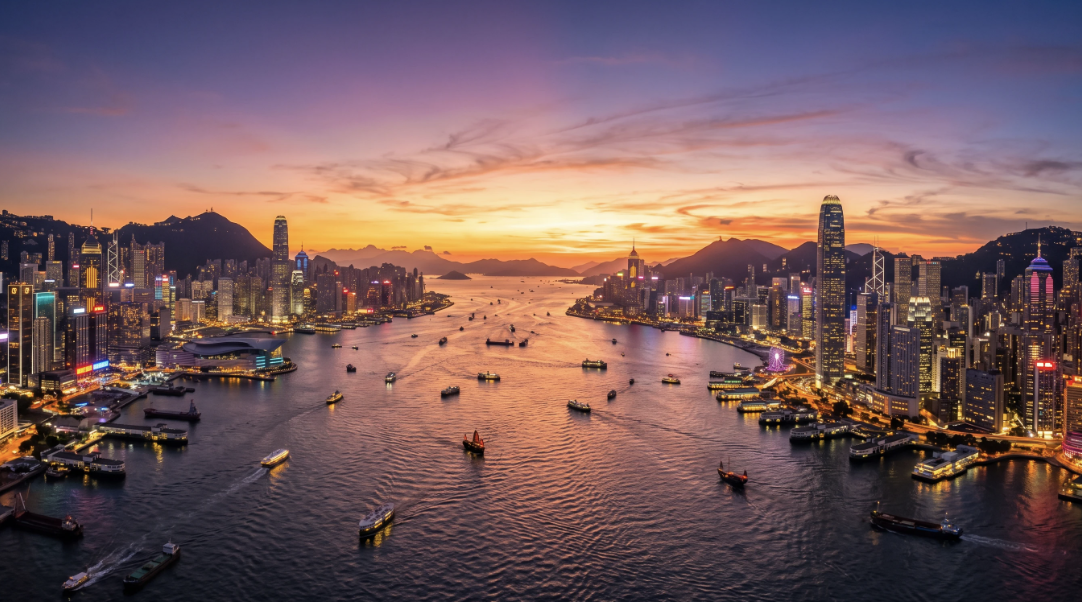
Hong Kong (香港) is one of those cities where the famous sights genuinely deserve their reputation, but the best trips come from joining them up properly. You can take the Star Ferry (天星小輪; tin1 sing1 siu2 leon4) across Victoria Harbour in the morning, eat a pineapple bun (菠蘿包; bo1 lo4 baau1) for afternoon tea, then watch the skyline light up from Victoria Peak (太平山頂; taai3 ping4 saan1 deng2) before dinner.
This first-time guide to the best Hong Kong attractions covers 16 places worth your time, including essential landmarks, markets, temples, museums, hiking trails and local food stops.
Why Hong Kong Is Worth Exploring
- Hong Kong’s MTR, buses, ferries and trams make independent travel straightforward, even for a short first visit.
- Urban views and proper countryside sit surprisingly close together: you can see Victoria Harbour in the morning and hike Dragon’s Back (龍脊; lung4 zek3) in the afternoon.
- Cantonese food culture is still central to everyday life, from Cha Chaan Teng (茶餐廳; caa4 caan1 teng1) cafés to seafood restaurants, bakeries and wet markets.
- An Octopus card (八達通; baat3 daat6 tung1) works on most public transport and is useful at convenience stores, supermarkets and many casual food outlets.
- Hong Kong rewards curiosity. The famous sights matter, but so do the small things: a tram ride, a ferry crossing, a temple visit, a bowl of noodles and a walk through a neighbourhood market.

16 Best Hong Kong Attractions for First-Time Visitors
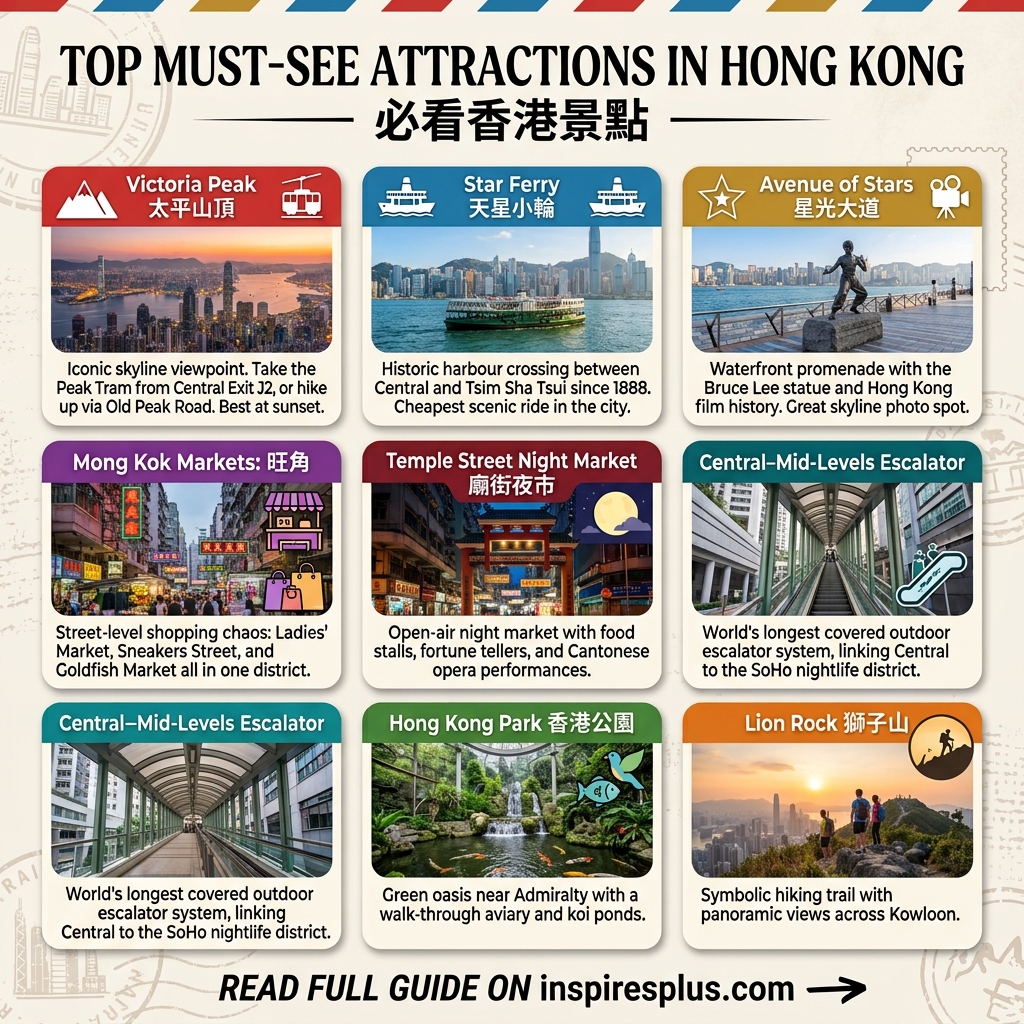
1. Victoria Peak / 太平山頂 (taai3 ping4 saan1 deng2)
The Peak is the classic Hong Kong skyline experience, and it is still worth doing properly. From Central MTR Station, use Exit J2 and walk uphill along Garden Road towards the Peak Tram Central Terminus at 33 Garden Road. The Peak Tram generally operates daily from 7:30am to 11pm, but maintenance closures do happen, so check the official Peak website before travelling.
For the best Hong Kong harbour views, arrive before sunset and stay until the buildings light up. The Sky Terrace gets crowded, so walk along Lugard Road afterwards for a wider and usually quieter view. If the Peak Tram queue is too long, bus 15 from Central is the sensible local alternative. You can also walk up Old Peak Road if you are fit and do not mind steep gradients.
2. Star Ferry / 天星小輪 (tin1 sing1 siu2 leon4)
The Star Ferry is one of the best-value Hong Kong attractions because it is not simply transport: it is a front-row harbour cruise for the price of a local crossing. The main route runs between Central Pier 7 and the Tsim Sha Tsui Star Ferry Pier. Tap your Octopus card at the gate and take the upper deck if you want the better view.
Use the ferry in daylight for clear skyline photographs or after dark for the lit-up waterfront. Service times and fares can change, so use the official Star Ferry website for the live timetable rather than relying on an old blog post.
Klook.com
3. Avenue of Stars / 星光大道 (sing1 gwong1 daai6 dou6)
The Avenue of Stars runs along the Tsim Sha Tsui waterfront and celebrates Hong Kong cinema with handprints, plaques and the well-known Bruce Lee (李小龍) statue. Take Tsim Sha Tsui MTR Exit E or Exit L6, then follow the waterfront towards the Hong Kong Cultural Centre.
This is one of the easiest places to photograph Victoria Harbour, especially in late afternoon. The free Symphony of Lights (幻彩詠香江) has historically been held at 8pm, but the programme is due to change under the government’s new tourism plans. Check the Tourism Commission’s official Symphony of Lights page before planning around it.

4. Mong Kok / 旺角 (wong6 gok3) Markets
Mong Kok is where to go when you want Hong Kong at street level: neon signs, tiny shops, beauty stores, snack stalls, mobile-phone accessories and constant foot traffic. The best-known market is Ladies’ Market (女人街; neoi5 jan4 gaai1) on Tung Choi Street. Nearby, Sneakers Street (波鞋街; bo1 haai4 gaai1) is useful for trainers, while Goldfish Market (金魚街; gam1 jyu4 gaai1) has the city’s distinctive aquarium and pet shops.
Use Mong Kok MTR Exit E2. Visit after 5pm for the liveliest atmosphere, but go earlier if you want more room to browse. Bargaining is normal at market stalls, although it is not a performance: make one reasonable offer, smile, and walk away if the price is not right.

5. Temple Street Night Market / 廟街夜市 (miu6 gaai1 je6 si5)
Temple Street is the classic Kowloon night-market stop, with souvenir stalls, fortune-telling tables, Cantonese opera performances and open-air seafood restaurants. The area starts to feel alive after 6pm, although individual stalls keep different hours. MTR: Jordan (佐敦; zo3 deon1), Exit A.
Do not go expecting a polished luxury market. Go for the noise, food smells, local characters and the pleasure of wandering without a fixed plan. If you eat at a dai pai dong (大排檔; daai6 paai4 dong3), check the price before ordering market seafood by weight.

6. Central–Mid-Levels Escalator / 中環至半山自動扶梯
The Central–Mid-Levels Escalator is an 800-metre covered system of escalators and walkways running from Central towards the Mid-Levels. It is useful for exploring SoHo (蘇豪; sou1 hou4), Tai Kwun, PMQ and the streets around Staunton Street and Elgin Street.
Know the direction before setting off: it runs downhill from 6am to 10am, then uphill from 10:20am until midnight. Start near Central MTR Exit C. The Transport Department maintains the system and provides updates on its official hillside escalator page.

7. Hong Kong Park / 香港公園 (hoeng1 gong2 gung1 jyun2)
Hong Kong Park is a calm stop near Pacific Place and Admiralty, with ponds, waterfalls, historic buildings and the Edward Youde Aviary. It is particularly useful if you need a break from shopping districts or if you are travelling with children. The park is at 19 Cotton Tree Drive, Central.
Use Admiralty MTR Exit C1. The park is generally open from 6am to 11pm and admission is free. The official Hong Kong Park website lists individual facility hours, including the aviary.

8. Lion Rock / 獅子山 (si1 zi2 saan1)
Lion Rock is one of Hong Kong’s most symbolic hiking routes, known for the view across Kowloon and for the phrase “Lion Rock Spirit” (獅子山精神; si1 zi2 saan1 zing1 san4). This is a proper hill hike, not a sightseeing stroll. The exposed upper sections can be slippery, hot and dangerous in poor weather.
Start from Wong Tai Sin MTR Exit B3 and follow Sha Tin Pass Road towards the trail. Allow at least two to three hours, carry water, and do not hike during heavy rain, thunderstorms or a typhoon signal. For current trail information, use the Hong Kong Tourism Board’s Lion Rock page.

9. Tai O Fishing Village / 大澳漁村 (daai6 ou3 jyu4 cyun1)
Tai O is a slower Lantau day trip built around stilt houses (棚屋; paang4 uk1), dried seafood stalls, canals and old fishing-village life. From Tung Chung, take bus 11; from Ngong Ping, take bus 21. Weekdays are quieter than weekends, when day-trip crowds can change the pace completely.
Boat trips sometimes advertise Chinese white dolphin (中華白海豚; zung1 waa4 baak6 hoi2 tyun4) sightings, but wildlife is never guaranteed. Go for the village itself, try grilled seafood or shrimp paste, and treat a dolphin sighting as a bonus. The Hong Kong Tourism Board’s Tai O guide is the best official planning reference.

10. West Kowloon Cultural District / 西九文化區 (sai1 gau2 man4 faa3 keoi1)
West Kowloon gives you a more contemporary side of the city: M+, the Hong Kong Palace Museum, the Xiqu Centre (戲曲中心; hei3 kuk1 zung1 sam1), Art Park and a broad harbourfront promenade. It is a strong late-afternoon choice because you can combine a museum visit with sunset over Victoria Harbour.
Use Kowloon MTR Exit E4, Austin Station, or walk from the Airport Express terminus. Check exhibitions, performances and individual venue hours on the official West Kowloon website.

11. PMQ / 元創方 (jyun4 cong3 fong1)
PMQ is the former Police Married Quarters at 35 Aberdeen Street, Central. It now houses independent designers, occasional exhibitions, cafés and small shops. It is worth adding to a Central and Sheung Wan walking route rather than treating it as a destination that needs half a day.
From Central, use Exit C and walk via the Central–Mid-Levels Escalator towards Staunton Street. From Sheung Wan, Exit E2 is often easier. Check pop-ups and opening details on the official PMQ website.

12. Kowloon Walled City Park / 九龍寨城公園 (gau2 lung4 zaai6 sing4 gung1 jyun2)
Kowloon Walled City Park is a quiet Chinese-style garden on the site of the former Kowloon Walled City. The old Walled City itself is gone, but the preserved Yamen building, historic artefacts and landscaped gardens make this a thoughtful stop for anyone interested in Hong Kong history.
The park is generally open from 6:30am to 11pm and entry is free. MTR: Lok Fu (樂富; lok6 fu4), Exit B, then continue by minibus 25M or local bus. Check current access information on the official LCSD Kowloon Walled City Park page.
.jpg)
13. Cheung Chau / 長洲 (coeng4 zau1)
Cheung Chau is a car-free island reached from Central Pier 5. The ferry journey usually takes around 35 to 60 minutes depending on whether you take the ordinary ferry or the faster service. Once there, walk beyond the main harbour rather than stopping at the first snack stalls.
Try the giant fishballs, steamed buns and seafood, then follow the Mini Great Wall (迷你長城; mai4 nei5 coeng4 seng4) path for coastal views. Ferry times can change with weather and service schedules, so use the Hong Kong Tourism Board’s Cheung Chau guide alongside the operator timetable before departure.
.jpg)
14. Hong Kong Tram / 電車 (din6 ce1)
The double-decker tram, known locally as the Ding Ding (叮叮), is the cheapest scenic ride on Hong Kong Island. It runs between Kennedy Town (堅尼地城; gin1 nei4 dei6 sing4) and Shau Kei Wan (筲箕灣; saau1 gei1 waan4), passing through Central, Wan Chai, Causeway Bay and North Point.
Board at the rear and pay with Octopus when leaving at the front. Sit upstairs at the front if you can, but avoid rush hour when the tram is more commuter transport than sightseeing. Route information is available on the official Hong Kong Tramways website.

15. Hong Kong Science Museum / 香港科學館 (hoeng1 gong2 fo1 hok6 gun2)
The Hong Kong Science Museum is a reliable rainy-day attraction at 2 Science Museum Road, Tsim Sha Tsui East. It has more than 500 exhibits, many designed for hands-on interaction, so it works well for families, older children and anyone needing an indoor break from the heat.
Permanent exhibition admission is HK$20 standard, HK$10 concessionary and free for full-time students; the permanent exhibition is also free on Wednesdays. It is normally closed on Thursdays except public holidays. Use the official Hong Kong Science Museum visitor page for current opening hours, ticket notices and temporary exhibitions. MTR: Tsim Sha Tsui Exit B2 or Hung Hom Exit D.

16. Dragon’s Back / 龍脊 (lung4 zek3)
Dragon’s Back is the most accessible introduction to Hong Kong hiking for confident first-time visitors. From Shau Kei Wan MTR Exit A3, walk to the bus terminus and take bus 9 towards Shek O. Get off at To Tei Wan, where the climb begins. The trail gives you views over Shek O, Big Wave Bay and the southern coastline.
Allow two to three hours, wear shoes with grip and take more water than you think you need. Do not hike in thunderstorms, extreme heat or poor visibility. For route guidance, see the official Hong Kong Tourism Board Dragon’s Back guide.

Cha Chaan Teng / 茶餐廳 (caa4 caan1 teng1) Food Experience
A Hong Kong food guide without a Cha Chaan Teng would be useless. These fast, inexpensive local cafés are where to try milk tea (奶茶; naai5 caa4), pineapple buns, macaroni soup, baked pork-chop rice and other Hong Kong comfort food. Service is brisk, tables may be shared, and staff expect you to order once you are seated.
Australia Dairy Company (澳洲牛奶公司; ou3 zau1 naai5 ngau4 gung1 si1) is at 47–49 Parkes Street, Jordan, near Jordan MTR Exit C2. Kam Wah Cafe (金華冰廳; gam1 waa4 bing1 teng1) is at 47 Bute Street, Prince Edward, around five minutes from Prince Edward Exit B2. Neither venue has a verified official website, so no external restaurant link has been added here. Turn up, queue patiently, order clearly and do not expect a slow brunch.

Essential Hong Kong Transport and MTR Exit Guide
| Attraction | Best station and exit | Practical route |
|---|---|---|
| Victoria Peak | Central, Exit J2 | Walk to Garden Road Peak Tram Terminus |
| Avenue of Stars | Tsim Sha Tsui, Exit E or L6 | Walk towards the waterfront and Cultural Centre |
| Big Buddha | Tung Chung, Exit B | Ngong Ping 360 cable car or bus 23 |
| Man Mo Temple | Sheung Wan, Exit A2 | Walk uphill along Hollywood Road |
| Wong Tai Sin Temple | Wong Tai Sin, Exit B2 | Short signed walk from the station |
| Dragon’s Back | Shau Kei Wan, Exit A3 | Take bus 9 to To Tei Wan |
| Cheung Chau | Central, Exit A | Walk to Central Pier 5 |
An Octopus card is the simplest way to pay for MTR journeys, buses, trams and ferries. If you are comparing stored-value transit cards across an East Asia itinerary, see our Tokyo transportation guide; the underlying logic of topping up, tapping in and checking route restrictions is very similar.
Hong Kong Travel Tips for First-Time Visitors
- Use an Octopus card: It saves time on the MTR, buses, ferries and trams, and is accepted at many convenience stores and casual food outlets.
- Carry some cash: Cards and mobile payments are widespread, but market stalls, small eateries and some minibuses may still prefer cash or Octopus.
- Mind MTR etiquette: Let passengers leave before boarding, queue behind floor markings and stand on the right on escalators.
- Plan for humidity: Hong Kong from May to September is hot and humid. Lightweight layers, a refillable bottle, sun protection and comfortable walking shoes are essential. Our East Asia travel-planning guide offers a useful framework for building a practical regional packing list.
- Choose location over a small hotel saving: Staying near an MTR station makes a major difference when you are visiting multiple districts. For a useful comparison method, see our guide to choosing the best area for first-time visitors.
Hong Kong First Visit FAQ
Do I need to tip in Hong Kong?
Many full-service restaurants add a 10% service charge. In Cha Chaan Teng cafés and casual local restaurants, a small amount of loose change is polite but not expected.
Is Hong Kong safe at night?
Most visitor areas, including Central, Tsim Sha Tsui, Causeway Bay, Mong Kok and the harbourfront, are generally safe to explore at night. Use the normal city precautions: keep bags closed in crowds, watch your belongings in markets and avoid unlicensed taxis.
How many days do I need in Hong Kong?
Three full days is enough for the major Hong Kong attractions, but four or five days lets you add Lantau, an outlying island, a museum day and a hiking route without rushing. If you are managing costs across several destinations, our East Asia travel budget guide can help you build a realistic daily spending plan.
Make the Most of Your Hong Kong Itinerary
The best Hong Kong itinerary balances the big sights with the everyday city. Take the Peak Tram, but also ride a normal tram. Photograph Victoria Harbour, but also eat in a busy Cha Chaan Teng. Visit a temple, spend time by the water, take a ferry, and leave room for one unscheduled walk through a neighbourhood that was not on your original list.
Before travelling, confirm live service notices through the official MTR website and review current attraction information through the official Hong Kong Tourism Board website. For wider regional trip planning and practical transport comparisons, you can also browse our InspiresPlus East Asia travel guides.
Infographic – Hong Kong Must See Attractions