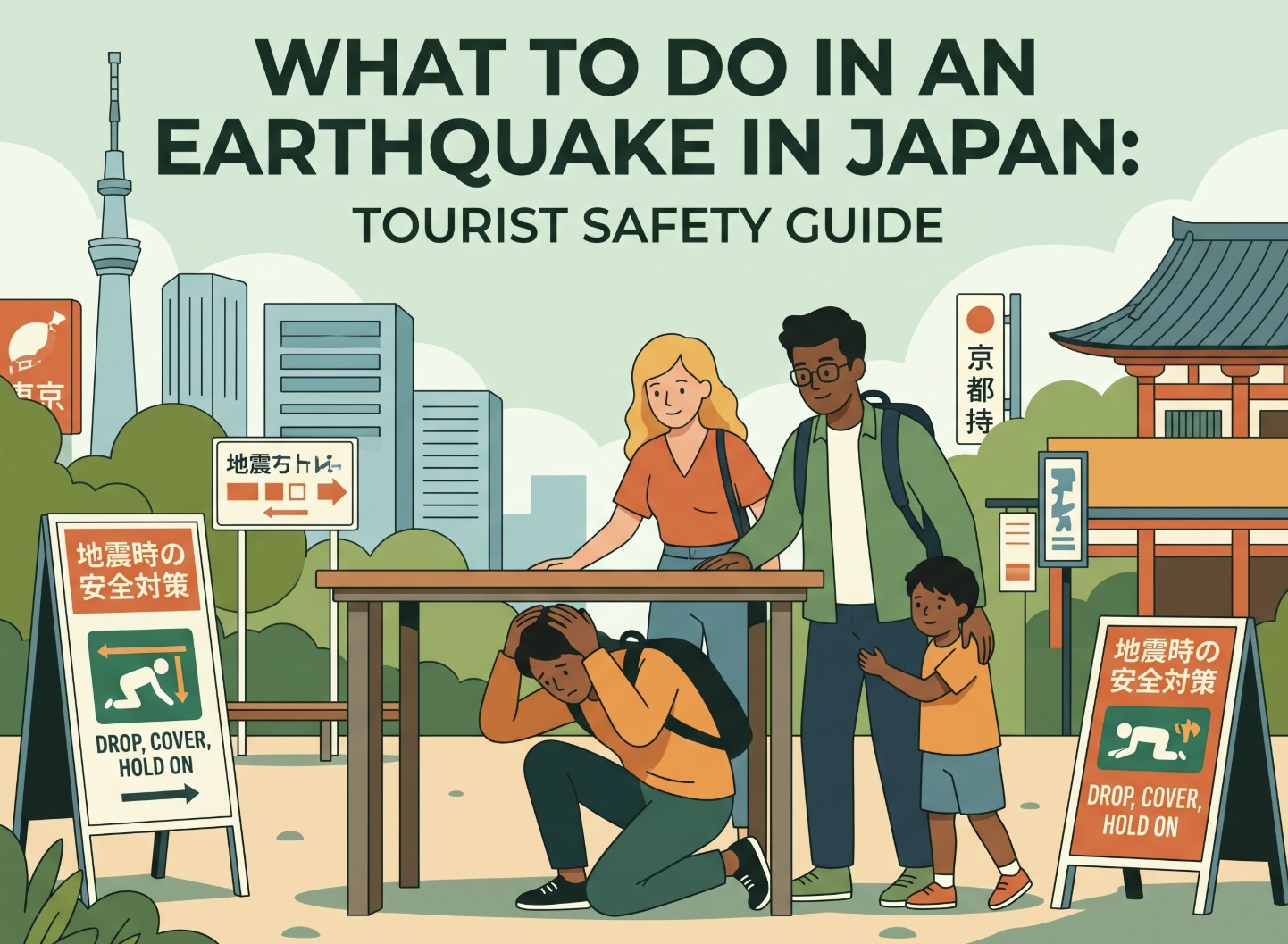
If an earthquake happens while you are visiting Japan, protect your head and neck, stay away from windows and falling objects, and do not rush outside while the ground is shaking. When the shaking stops, follow instructions from staff and local authorities, avoid lifts and check official alerts. If you are near the coast and feel strong shaking, or weak but long-lasting shaking, move to higher ground or inland as soon as it is safe to do so because a tsunami may follow.
This article is intended as general travel guidance only. In any emergency, always follow instructions issued by local authorities, emergency services, accommodation staff and transport operators.
Earthquakes are a fact of life in Japan, and visitors should understand how to respond. Hotels, railway operators, museums, shops and public buildings may have emergency procedures, while Japanese authorities provide visitor-focused safety information in several languages. Knowing the right response will help you stay calm and act sensibly if an earthquake happens during your trip.
Whether you are sightseeing in 東京 (Tokyo), staying in 京都 (Kyoto), riding the 新幹線 (Shinkansen) to 大阪 (Osaka), relaxing in 沖縄 (Okinawa) or hiking near 富士山 (Mount Fuji), the key principle remains the same: protect yourself first, then follow official instructions.
The first rule: protect yourself first
During an earthquake, do not make collecting luggage, filming the event, calling home or finding an exit your first priority. The immediate danger is injury from falling or breaking objects, including glass, signs, shelves, ceiling fittings, unsecured furniture and decorative items.
A useful safety routine is drop, cover and hold on. Get low to the ground so you are less likely to fall. Cover your head and neck with your arms, bag, jacket, cushion or other available protection. If there is a sturdy table nearby, shelter underneath it and hold onto it until the shaking ends.
- Drop: Get low so that you are less likely to lose your balance.
- Cover: Shield your head and neck from falling items or broken glass.
- Hold on: Hold a stable object, such as a table or rail, until the movement stops.
Do not automatically run towards a doorway. A doorway is not always safer than another part of a modern building, and running through a crowded hotel, shop or station can create additional risks. Stay where you are during the shaking unless there is an immediate danger, such as falling glass directly above you.
What to do in different places
| Where you are | What to do during the shaking | What to do afterwards |
|---|---|---|
| Hotel, ryokan or holiday apartment | Move away from windows and tall furniture. Shelter under a sturdy table where possible, or protect your head with a pillow, duvet or bag. | Put on shoes, take essential items only and use stairs rather than lifts. Follow accommodation staff instructions. |
| Train, Shinkansen or metro | Remain seated if possible. If standing, hold a rail, strap or seatback firmly. Do not try to open doors or leave the carriage. | Wait for railway staff instructions. Services may be delayed or suspended while safety checks are completed. |
| Street or outdoor attraction | Move away from glass façades, signs, walls, utility poles and trees. Cover your head with a bag or jacket. | Follow local instructions and move to an open area, such as a park or designated evacuation space, if directed. |
| Shop, restaurant or department store | Step away from shelves, displays and windows. Crouch low and protect your head. Do not push towards exits. | Follow staff announcements. Expect temporary closures and possible disruption to transport or local services. |
| Beach, harbour or coastal area | Protect yourself from immediate falling hazards, but be ready to leave once the shaking stops. | After strong shaking, or weak but long-lasting shaking, evacuate uphill or inland immediately because of tsunami risk. |
If you are in a hotel, ryokan or Airbnb
When you check into a hotel or 旅館 (ryokan), take a minute to identify the nearest emergency exit and stairwell. Emergency information may be displayed on the back of the room door, near the lift or in the guest information folder. Ask reception if you cannot identify the nearest emergency exit and stairwell.
During the shaking, stay away from windows, mirrors, large wardrobes and anything that could topple. If you are in bed, use a pillow or duvet to protect your head and neck. When the movement stops, put on shoes before walking around: broken glass, damaged light fittings and fallen objects can make barefoot walking unsafe.
If staff tell guests to evacuate, take your phone, passport, medication, water and an outer layer if these are immediately accessible. Do not delay to pack your suitcase. Do not use a lift after an earthquake. Use stairs and follow staff to the designated evacuation area.
What to do on a train or Shinkansen
Japanese rail services may slow down or stop during significant seismic activity while operators check tracks, overhead lines and stations. A sudden stop can feel alarming, especially if you are on a crowded commuter train, but your safest choice is to remain in the carriage and follow instructions from railway staff.
Stay seated if you have a seat. If you are standing, hold a strap, rail or seatback securely. Do not force doors, move between carriages or attempt to leave the train without being instructed to do so. Staff will provide safety directions. Information may be given in Japanese, and English support varies by operator, route and location. Follow staff instructions even if you do not fully understand every announcement.
After a stronger earthquake, train disruption may last longer than expected because safety inspections take priority over timetables. Keep a power bank in your day bag, save your hotel address offline and build flexibility into any long-distance travel day.
Tsunami safety for coastal Japan
Tsunami risk requires a fast and decisive response. If you are close to the sea, a river mouth, harbour or low-lying coastal district and feel strong shaking, or weak but long-lasting shaking, leave the area as soon as it is safe to move. Go uphill or inland immediately.
Do not wait for a social-media post, a news update or visible signs from the sea. Do not return to your hotel for luggage. Do not go to the beach or harbour to watch for a wave. Tsunami waves can arrive repeatedly, travel up rivers and affect coastal areas after the original earthquake has ended.
Look for evacuation signs marked 津波避難場所 (tsunami evacuation place) or 津波避難ビル (tsunami evacuation building). Follow the signed route, move to higher ground and remain there until authorities cancel the tsunami warning. This is particularly important when visiting destinations such as 鎌倉 (Kamakura), 伊豆 (Izu), 静岡 (Shizuoka), 宮島 (Miyajima), 和歌山 (Wakayama), 沖縄本島 (Okinawa Main Island) and coastal parts of 北海道 (Hokkaido).
What to do after the shaking stops
When the shaking stops, pause and check your surroundings. Aftershocks may happen, and local authorities may need time to inspect buildings, roads and transport networks. Avoid making decisions based on rumours, viral videos or unverified posts online. Follow instructions from staff, police, railway operators and local authorities.
- Use stairs rather than lifts if you are instructed to leave a building.
- Keep away from visibly damaged buildings, cracked walls, cliffs, riverbanks and overhead cables.
- Do not smoke, light a flame or turn electrical equipment on if you suspect a gas leak.
- Wear shoes and use a torch or phone light if there is a power cut.
- Send a short text message to family or friends once you are safe instead of making repeated calls.
- Keep some yen cash available, as card terminals and cash machines may be temporarily unavailable.
- Expect transport, shops, attractions and restaurants to close or operate differently after a major incident.
Japanese local authorities designate evacuation areas and evacuation shelters. An evacuation area is generally an open place used to escape immediate danger, such as a park, school ground or public square. A shelter, known as a 避難所 (hinanjo), may be opened for people who cannot safely return to their accommodation. Availability and instructions depend on the specific emergency, so follow local authority guidance and ask hotel staff for help if needed.
What tourists should prepare before travelling
You do not need to carry a large emergency kit throughout Japan. A practical day bag is enough for most visitors. Carry a charged phone, compact power bank, a small bottle of water, essential medication, tissues, a light waterproof layer, some yen and a photograph or paper copy of your passport details.
Before departure, download Japan’s official Safety Tips app for international visitors. It provides multilingual notifications for earthquake early warnings, tsunami warnings and severe weather. Local authorities, emergency services, accommodation staff and railway operators should always be your primary source of instructions during an incident.
Save the JNTO Japan Visitor Hotline number, 050-3816-2787, before you fly. This number is for calls made from within Japan. From overseas, call +81-50-3816-2787. The hotline operates 24 hours a day and provides visitor support in English, Chinese and Korean. It is useful for travel-related help and guidance, but it is not a replacement for emergency services. Call 110 for police, or 119 for an ambulance or fire service in an immediate emergency.
Reliable mobile data can be useful for receiving alerts, using maps, contacting accommodation and translating information. A travel eSIM can help you stay connected from arrival. However, mobile data should support your travel safety plan, not replace basic preparation. Keep some yen cash, know your hotel address and carry a small power bank.
Useful Japanese phrases during an earthquake
- 地震です (jishin desu): It is an earthquake.
- 避難してください (hinan shite kudasai): Please evacuate.
- 高い場所へ避難してください (takai basho e hinan shite kudasai): Please evacuate to higher ground.
- 津波 (tsunami): Tsunami.
- 非常口 (hijōguchi): Emergency exit.
- 避難所 (hinanjo): Evacuation shelter.
- 大丈夫ですか? (daijōbu desu ka?): Are you all right?
Official resources for visitors
- JNTO Safety Tips for Travellers
- JNTO: What to Do During an Earthquake
- JNTO: Staying Safe in Japan
- Japan Meteorological Agency: English-language homepage
Frequently Asked Questions
- Should I run outside during an earthquake in Japan? Usually, no. During the shaking, protect yourself from falling objects and glass where you are. Rushing outside can expose you to debris, signs and crowds. Leave only once it is safe and you are instructed to do so.
- What should I do if an earthquake happens on the Shinkansen? Stay seated where possible, or hold a rail if you are standing. Do not try to open doors or leave the carriage. Wait for railway staff to provide instructions.
- Do tourists need to evacuate after every earthquake in Japan? No. Many tremors are minor and do not require evacuation. Follow staff announcements and official alerts. However, if you are near the coast after strong shaking, or weak but long-lasting shaking, evacuate to higher ground or inland immediately because of potential tsunami risk.
- What app should I download for earthquake alerts in Japan? Download the official Safety Tips app before travelling. It provides multilingual alerts for earthquakes, tsunami warnings and severe weather for international visitors.
Disclaimer: This article is intended as general travel guidance only and may not reflect a live emergency situation. In any emergency, always follow instructions issued by local authorities, emergency services, accommodation staff, transport operators and official Japanese warning systems. Do not rely on this article or an app as a substitute for immediate safety action.