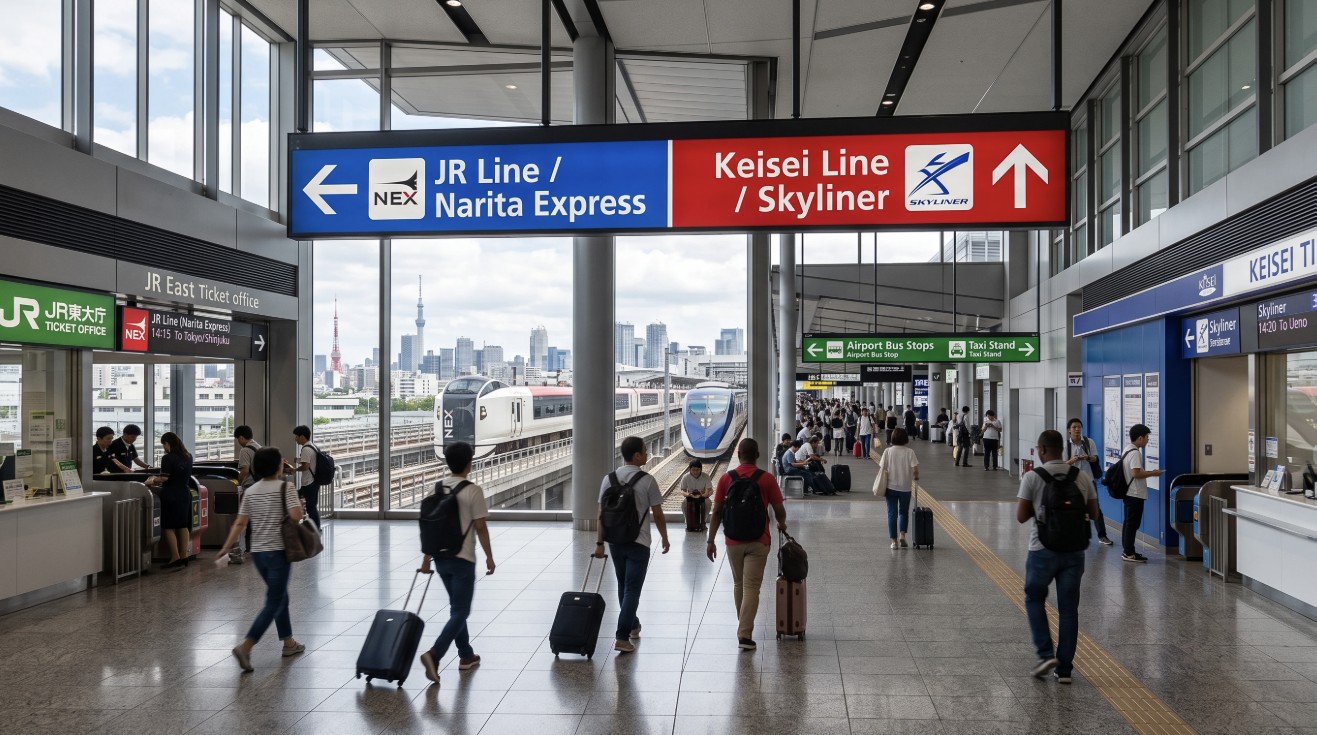
Getting from Narita Airport (成田空港, Narita Kuko) to central Tokyo is the first logistical decision of most Japan trips. The fastest and most comfortable options are the JR Narita Express and Keisei Skyliner, though limousine buses, budget local trains and taxis are all available depending on your priorities for price, speed or convenience. This guide covers routes, current fares and booking tips to help you choose the right transfer for your arrival.
Quick Overview: Main Transfer Options
Narita Airport sits roughly 60km east of Tokyo Station (東京駅), a considerable distance after a long flight. Most travellers choose from five main routes into the city.
- Narita Express (N’EX): A fast, comfortable JR train running direct to major city stations including Tokyo, Shibuya, Shinjuku and Yokohama.
- Keisei Skyliner: A high-speed train to Ueno (上野) and Nippori (日暮里), convenient for northern and eastern Tokyo.
- Limousine Bus: An airport coach serving many major hotels and city hubs around Tokyo.
- JR or Keisei Local Trains: Budget-friendly and frequent, but considerably slower with more stops.
- Taxi or Private Transfer: Door-to-door convenience at a premium price, calculated by distance and time.
Both the N’EX and Skyliner can be booked online in advance or on arrival at the airport. For speed and direct access to central Tokyo stations, these two remain the standard choice for most visitors.
General Travel Tips for International Arrivals
After landing at Narita (NRT), you will pass through immigration and customs before reaching the arrivals hall in Terminal 1, 2 or 3. Signage is clear and multilingual, though the airport is large, so allow at least 45 to 60 minutes from landing to being ready to depart.
- Wi-Fi and eSIM: Setting up a Japan eSIM before boarding your transport, or picking up a pocket Wi-Fi device at the airport, makes it easier to check train times and routes on arrival. For eSim, you can easily purchase it from Trip.com or Kook. Click here to explore different types of eSim with different length of day and different data allowance that is available on Trip.com.
- Travel money: ATMs with English menus are available in the arrivals area. Most ticket machines and vending machines now accept IC cards such as Suica or PASMO, or major credit cards, so you generally only need a small amount of cash.
- Advance booking: Reserving train or bus tickets in advance, either through official JR East and Keisei sites or via Klook and Trip.com, is worthwhile during busy arrival periods or peak travel seasons.
- Check your hotel location: Knowing whether your accommodation sits near a JR or Metro station will influence which transfer option makes the most sense for you.
Narita Express (N’EX): Direct JR Train to Central Tokyo
The Narita Express is JR East’s flagship airport rail service. It runs from Narita’s terminals to Tokyo Station in around 53 minutes, continuing on to stops such as Shinagawa (品川), Shibuya (渋谷), Shinjuku (新宿), Ikebukuro and Yokohama. All seats are reserved, and trains run roughly every 30 to 60 minutes from early morning to evening.
- Standard adult fare: 3,140 yen to Tokyo Station, or 3,330 yen to Shinagawa, Shibuya or Shinjuku
- Route: Narita T1/T2/T3, then Tokyo, Shinagawa, Shibuya, Shinjuku, Ikebukuro or Yokohama depending on the service
- Luggage: Dedicated racks plus overhead storage
- JR Pass: Fully covered by the Japan Rail Pass and JR East Pass, with a free seat reservation available at the JR ticket counter
The N’EX suits travellers heading to central Tokyo or connecting onward to the Shinkansen network. Advance seat reservations are worth making for families or groups, though same-day bookings are usually straightforward using ticket machines with English-language support.
Official fares and booking: JR East, N’EX tickets and fares
Keisei Skyliner: The Fastest Train to Ueno and Nippori
The Keisei Skyliner runs on a dedicated line, reaching Nippori in around 36 minutes and Ueno in around 41 to 45 minutes. It suits travellers staying in Asakusa (浅草), Akihabara (秋葉原), Ueno or elsewhere on Tokyo’s northeast side. As with the N’EX, all seats are reserved.
- Standard adult fare: 2,580 yen to Keisei Ueno or Nippori Station when paying by IC card or at the ticket machine
- Trains every: Roughly 20 to 40 minutes, from early morning to evening
- IC card: Accepted, though the reserved seat liner fee always applies on top of the base fare
- Best for: The fastest airport-to-city transfer, with direct access to northern and eastern Tokyo
If your hotel sits along the Tokyo Metro Ginza Line or the northern arc of the Yamanote Line, the Skyliner is generally the most efficient option. Booking online in advance through platforms such as Klook can sometimes offer a modest discount compared with walk-up fares.
Book online: Keisei Skyliner ticket via Klook
Limousine Bus: Direct to Major Tokyo Hotels
The Narita Airport Limousine Bus service connects the airport to dozens of hotels and major stations across Tokyo, including Shinjuku, Ginza, Roppongi (六本木) and Tokyo Disney Resort. Buses run throughout the day into the evening, with luggage handled by the driver and free Wi-Fi onboard.
- Standard adult fare: 3,600 yen to the Shinjuku area, with fares to other destinations varying by route
- Travel time: Usually 80 to 120 minutes, depending on traffic
- Bookings: Advance booking is recommended during peak periods, either through the official Limousine Bus site or via Trip.com
- Best for: Travellers with substantial luggage or those wanting direct hotel drop-off
This is a good choice when travelling with elderly relatives or when your hotel is well outside walking distance of a city station, since it avoids the need for train transfers with heavy luggage.
Official site: Narita Airport Limousine Bus, official site
Local Train Options: Budget-Friendly but Slower
Budget-minded travellers, or those arriving late at night after the last express services, often use local commuter trains instead. Both JR and Keisei run frequent services that stop at most stations along the way, meaning journeys of around 75 to 120 minutes into central Tokyo.
- JR Narita Line (rapid service): Covered by the Japan Rail Pass, reaching Tokyo Station in around 90 to 100 minutes
- Keisei Main Line or Access Express: The cheapest regular train option to Nippori or Ueno, taking roughly 60 to 75 minutes
- IC cards: Suica, PASMO and other prepaid transport cards are accepted throughout
This is a sensible choice for short stays on a tight budget, or when arriving after the last N’EX or Skyliner departures, which generally run until around 9:30 to 10pm.
Taxi and Private Transfer: Door-to-Door at a Premium
Taxi stands are clearly marked outside Narita’s terminals, and staff can help arrange fixed-fare rides to central Tokyo. Fares for an ordinary taxi to central Tokyo are calculated by distance and time and can run considerably higher than any of the train or bus options, particularly at night, so it is worth confirming the current estimated fare with the taxi company or a pre-booking platform before you travel rather than relying on a fixed figure.
Pre-booked private transfer vans and chauffeur cars offer a fixed rate agreed in advance and can be a practical choice for groups, families or travellers with substantial luggage, since everything is arranged from arrival through to your hotel lobby.
- Best for: Jet lag, large families, business travellers, those with limited mobility, or late-night arrivals after trains have stopped running
Comparison: Narita Airport to Tokyo Transfer Options
| Method | Route/Destination | Duration | Standard Fare (Adult) | Recommended For |
|---|---|---|---|---|
| Narita Express (N’EX) | Tokyo, Shinjuku, Shibuya, Yokohama | 53 to 90 min | 3,140 to 4,480 yen | JR Pass users, central Tokyo, onward Shinkansen |
| Keisei Skyliner | Ueno, Nippori | 36 to 45 min | 2,580 yen | Staying in east or north Tokyo, Ueno area |
| Limousine Bus | Major hotels, city hubs | 80 to 120 min | 3,600 yen (Shinjuku route) | Lots of luggage, direct hotel drop-off |
| Local Train | Tokyo, Ueno, Nippori | 60 to 100 min | 1,050 to 1,340 yen | Budget or late-night arrivals |
| Taxi/Private Car | Anywhere in Tokyo | 60 to 90 min | Distance-based, confirm current rate | Groups, large bags, convenience |
Handy Booking Tips
- Tickets for the N’EX, Skyliner and Limousine Bus can be booked online through official JR East and Keisei sites, through Klook or Trip.com, or at dedicated counters in the arrivals hall on the day of travel.
- Travel insurance with delayed arrival coverage is worth considering, since weather or immigration queues can occasionally disrupt tight connections.
- Keep your phone charged or carry a printed ticket for digital bookings, since Wi-Fi coverage can be inconsistent once you leave the terminal building.
- Topping up a Suica or PASMO IC card on arrival makes onward travel around Tokyo far easier once you are in the city.
Check terminal maps in advance, since Narita’s three terminals are connected by a free shuttle bus. Knowing where you will land helps you find your train, bus or taxi more quickly and cuts down on unnecessary walking with luggage.
Official Resources
- Japan National Tourism Organization official guide
- Japan Travel UK, including transportation planning
- Visit Japan Web, official pre-arrival procedures
Frequently Asked Questions
Is it cheaper to buy a Narita Express or Skyliner ticket in advance?
Booking online through platforms like Klook sometimes offers a modest discount over walk-up station prices, particularly for the Skyliner. Walk-up fares at the station generally match the official rate, but certain online-only voucher deals are worth comparing before you travel.
Do I need a Japan Rail Pass for the N’EX?
No, a JR Pass is not required, but it fully covers the N’EX if you already hold one. For short city stays without onward Shinkansen travel, a standard one-way or round-trip N’EX ticket is usually better value than a full rail pass.
Which transfer should I take for Tokyo Disney Resort?
The Limousine Bus runs directly to Tokyo Disney Resort and nearby hotels. Taking the N’EX or Skyliner instead means changing to a local train at Tokyo or Ueno Station to complete the journey.
How late do trains to the city run?
The last Skyliner and N’EX services generally depart between around 9:30pm and 10pm, though exact times vary by day, so check the current timetable before you travel. Local JR and Keisei trains run somewhat later, and taxis remain the only reliable option after the last trains have gone.
Bookmark this guide for your arrival at Narita, and check official JR East, Keisei and Limousine Bus timetables closer to your travel date, since schedules and fares are reviewed periodically.