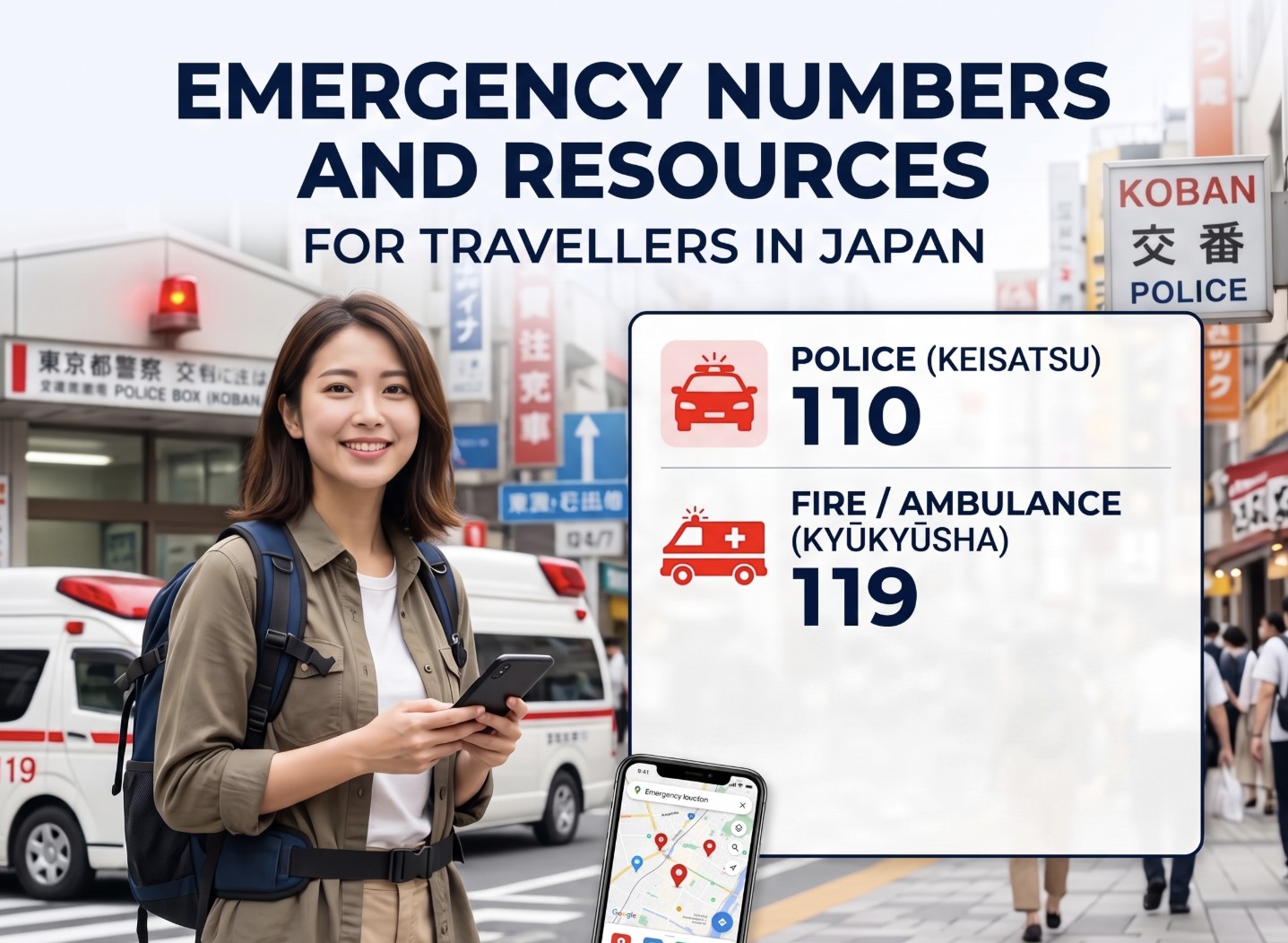
Before travelling to Japan, save 119 for an ambulance or fire emergency, 110 for police and 118 for emergencies at sea. International visitors should also save the 24-hour JNTO Japan Visitor Hotline, 050-3816-2787, and bookmark official safety resources before departure. In any immediate emergency, call the correct emergency number first and follow instructions from local authorities, emergency services, accommodation staff and transport operators.
Disclaimer: This article provides general travel information only and must not be relied on as live emergency advice. Telephone services, availability, procedures and official guidance may change. In an immediate emergency, call 110, 119 or 118 as appropriate, and always follow instructions issued by Japanese authorities and emergency personnel.
Japan is a safe, efficient and exceptionally well-organised destination, but it is still important to know where to get help if something goes wrong. Whether you are dealing with illness in 東京 (Tokyo), a lost passport in 京都 (Kyoto), a road accident in 大阪 (Osaka), an earthquake in 札幌 (Sapporo) or a coastal incident in 沖縄 (Okinawa), having the correct number saved can reduce stress at an already difficult moment.
Do not wait until an emergency to search for help. Save the numbers below before flying from the UK, keep your accommodation address available offline and make sure your phone has mobile data or access to Wi-Fi. A screenshot of this page, a charged power bank and a small amount of yen are also sensible additions to your Japan day bag.
The three emergency numbers to save
| Number | Use it for | When to call |
|---|---|---|
| 119 | Ambulance and fire service | Serious illness, serious injury, fire, major accident or immediate medical emergency. |
| 110 | Police | Crime, assault, theft in progress, traffic accident, immediate danger or urgent police assistance. |
| 118 | Japan Coast Guard | Maritime accidents, emergencies at sea, people in danger in the water or other urgent coastal incidents. |
These numbers are for genuine emergencies. Call 119 if someone is seriously ill or injured, has difficulty breathing, is unconscious, has a severe allergic reaction, is badly bleeding, has suffered a serious accident or needs urgent medical attention. The same number is used to report a fire.
Call 110 for urgent police assistance. This can include a crime in progress, assault, a serious traffic collision, an immediate threat to someone’s safety or a situation where police attendance is required. If you have simply misplaced an item or need non-urgent advice, speak with staff at your hotel, a nearby police box known as a 交番 (kōban), or use an appropriate non-emergency contact route instead.
Call 118 for an emergency at sea. This includes a boating accident, a person in danger in the water, a request for rescue at sea or other maritime incidents. It is most relevant to travellers taking boat tours, island ferries, diving trips, coastal excursions or water activities around destinations such as 石垣島 (Ishigaki Island), 宮古島 (Miyako Island), 伊豆諸島 (Izu Islands) and 北海道 (Hokkaido).
How to call an ambulance in Japan
In a serious medical emergency, call 119 and ask for an ambulance. The Japanese phrase is 救急です (kyūkyū desu), meaning “It is an ambulance emergency”. If there is a fire, say 火事です (kaji desu), meaning “It is a fire”.
Stay on the line and provide the clearest possible location. Give your hotel name, street address, building name, nearby station, landmark or visible shop. If you are outdoors and do not know the address, use your map location, identify a nearby crossing or ask another person to help explain where you are. Do not hang up until the operator tells you to do so.
If you are with someone who is very unwell or seriously injured, do not attempt to travel across the city by train, taxi or on foot if it could make their condition worse. Call 119. If the situation is not immediately life-threatening, contact your travel insurer’s medical-assistance line, ask your hotel to help locate a clinic, or use an official medical-information resource.
Police help, lost property and safety concerns
Japan has local police boxes, called 交番 (kōban), throughout cities, towns and transport hubs. They are useful if you are lost, have found an item, need to report a non-urgent issue or require help locating a local police station. However, do not walk to a kōban instead of calling 110 if there is immediate danger or an urgent crime.
If your passport is stolen, report the theft to police and contact the British Embassy in Tokyo for consular guidance. If your passport is simply lost, your hotel, the local police and the relevant transport operator may be able to help you check lost-property systems. Keep a separate digital copy of your passport photograph page and travel-insurance details in secure cloud storage before departure.
For travellers in Tokyo needing English-language police support, the Metropolitan Police Department has an English helpline at 03-3501-0110. This does not replace 110 for urgent police emergencies. For an immediate threat, crime in progress or serious accident, call 110 first.
JNTO Japan Visitor Hotline
The Japan National Tourism Organization, known as JNTO, runs the Japan Visitor Hotline for foreign visitors. The number is 050-3816-2787 when calling from within Japan, and +81-50-3816-2787 from overseas. It operates 24 hours a day, 365 days a year, with support in English, Chinese and Korean.
The hotline can provide assistance and information for visitors experiencing illness, accidents, natural disasters and travel-related difficulties. It can also help with general tourism information and may direct visitors to relevant services. It is not an emergency dispatch number: if someone needs an ambulance, fire service or urgent police response, call 119 or 110 instead.
Official JNTO links are included below. Each opens in a new tab:
- JNTO: Staying Safe in Japan
- JNTO: Safety Tips for Travellers
- JNTO: What to Do During an Earthquake
- JNTO: Japan Visitor Hotline and visitor emergency information
Official medical and disaster resources
For live disaster information, use official sources rather than social-media speculation. The Safety Tips for Travellers website is designed for overseas visitors and provides links to weather warnings, earthquake information and emergency guidance.
The Japan Meteorological Agency (JMA) is Japan’s official authority for weather, earthquake, tsunami and volcanic information. Its warnings and advisories are particularly important if you are travelling near the coast, hiking, skiing, taking domestic flights or visiting islands.
If you are near the coast and feel strong shaking, or shaking that continues for a long time, do not wait to search online. Move to higher ground or inland as soon as it is safe to do so, follow tsunami evacuation signs and listen to local authority instructions. A tsunami warning can apply to specific coastal regions, so avoid making assumptions based on conditions elsewhere in Japan.
For overseas visitors who feel unwell but do not have an immediately life-threatening emergency, JNTO’s official medical guidance explains how to find medical institutions and local consultation services. Your hotel reception, travel insurer and tour operator may also be able to help locate an appropriate clinic or hospital. Always confirm whether a clinic is open and able to accept you before travelling there.
British Embassy support for UK travellers
British nationals can contact the British Embassy Tokyo for consular information. The Embassy can provide assistance in situations such as a lost or stolen passport, serious crime, arrest, a death or a major crisis. It cannot replace Japanese emergency services, pay medical bills, provide routine translation, or make decisions for local authorities.
For urgent consular assistance, use the contact instructions on the official British Embassy Tokyo page. Save your travel-insurance policy number and 24-hour assistance number separately; insurers are often the appropriate first point of contact for non-emergency medical arrangements, hospital guarantees and repatriation support.
Practical preparation before your trip
- Save 119, 110, 118 and 050-3816-2787 in your phone before departure.
- Keep a screenshot of your accommodation name, full address and telephone number.
- Download the official Safety Tips app and enable emergency notifications.
- Bookmark JNTO and JMA emergency-information pages in your browser.
- Carry a charged power bank and keep important details available offline.
- Store passport copies, travel-insurance details and emergency contacts securely online.
- Carry some yen cash in case card payments or cash machines are temporarily unavailable.
- Tell your travel companions about any serious allergies, medication or medical conditions.
For mobile data, an eSIM from a provider can help you access maps, accommodation details and official websites from arrival. This is a travel-planning tool rather than an emergency service, so do not depend on connectivity alone. Know the main emergency numbers and keep your hotel details offline.
Frequently Asked Questions
- What number do I call for an ambulance in Japan? Call 119 for an ambulance or fire emergency. Use it when someone is seriously ill, seriously injured, unconscious, struggling to breathe or needs urgent medical help.
- What is Japan’s police emergency number? Call 110 for urgent police assistance, including crimes, serious traffic accidents, assault or an immediate threat to safety.
- What is the JNTO Japan Visitor Hotline number? The number is 050-3816-2787 within Japan, or +81-50-3816-2787 from overseas. It operates 24 hours a day, 365 days a year, in English, Chinese and Korean.
- What should I do if I lose my passport in Japan? Report a theft to police if applicable, contact the British Embassy Tokyo through its official website and speak with your hotel for practical help. Keep a digital copy of your passport and travel-insurance documents before travelling.
Disclaimer: This article is intended as general travel information only. It is not medical, legal, consular or emergency-service advice, and it may not reflect a live situation. In an immediate emergency in Japan, call 119 for ambulance or fire services, 110 for police, or 118 for maritime emergencies. Always follow Japanese authorities, emergency personnel, accommodation staff and transport operators. Check the official links in this article before travelling, as contact details and procedures can change.