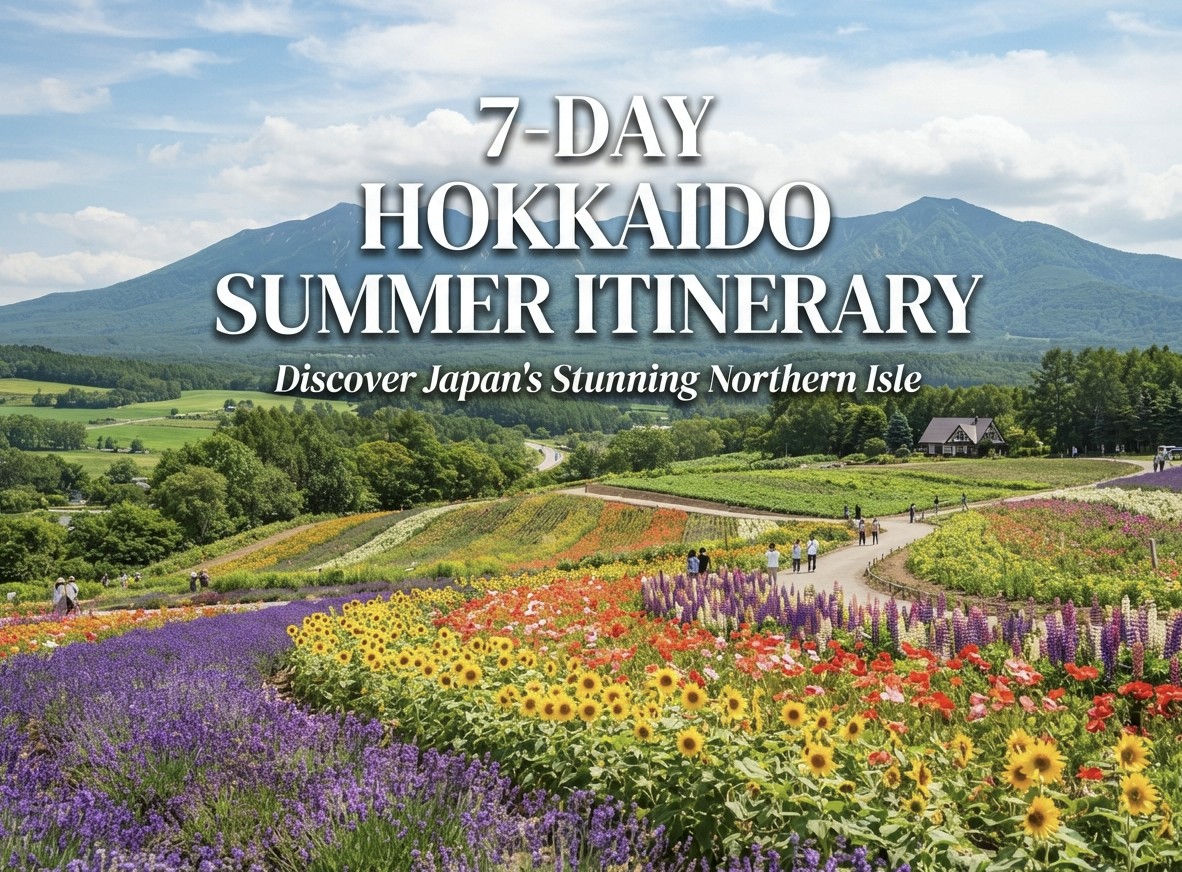
A well-built Hokkaido summer itinerary works around Sapporo as a rail hub: two days in the city, a day trip to Otaru, two days in the Furano–Biei flower belt during peak Furano lavender season, one day for Asahikawa or a hot spring detour, and a final buffer day for shopping before departure. The whole route runs without a hire car, using the JR Hokkaido Rail Pass for seven consecutive days. This year carries an extra reason to plan carefully: the Furano-Biei Norokko sightseeing train, a fixture of Hokkaido summers since 1998, is running its final season, with the last service scheduled for 28 September 2026.
Before You Book: Practical Foundations
Flights and Airport Transfer
New Chitose Airport (新千歳空港) is Hokkaido’s gateway. The JR Rapid Airport service runs to Sapporo Station (札幌駅) roughly every 15 minutes, taking about 37 minutes and costing ¥1,230 for a non-reserved seat, or ¥2,230 if you want the reserved Car No. 4. Transiting via Tokyo first? Our guides to the Narita Airport to Tokyo transfer and Haneda Airport to Tokyo cover the connecting leg.
Klook.comThe JR Hokkaido Rail Pass Decision
The JR Hokkaido Rail Pass costs ¥22,000 for five days, ¥28,000 for seven days and ¥37,000 for ten days, and is sold only to non-Japanese passport holders. It is one of the few Hokkaido passes that fully covers the region’s limited express trains, which is worth underlining: unlike some mainland JR services, Hokkaido’s limited expresses (the Lilac, Kamui, Hokuto and Suzuran) have no unreserved carriages at all — every seat on board is reserved, and the pass includes that reservation at no extra cost. It also covers the seasonal Furano Lavender Express and, crucially, the Furano-Biei Norokko sightseeing train’s base fare, with JR Hokkaido’s own pass page confirming no additional charge applies to the Norokko’s reserved seat for pass holders. Pre-purchasing online through Klook secures the discounted advance rate rather than the higher walk-up price at a JR counter.
| Journey | 2026 Fare (cash price, one-way unless noted) |
| Airport transfers (return, Rapid Airport, non-reserved) | ¥2,460 |
| Sapporo ⇄ Otaru (return, non-reserved) | ¥1,600 |
| Sapporo → Furano (Furano Lavender Express, all seats reserved) | ¥5,220 |
| Furano → Biei → Asahikawa (local trains) | ¥1,380 |
| Furano → Asahikawa (full-route Norokko, final season, reserved seat included) | ¥2,290 |
| Asahikawa → Sapporo (Ltd Exp Lilac/Kamui, all seats reserved) | ¥5,440 |
| Sapporo ⇄ Noboribetsu (return, Ltd Exp Hokuto/Suzuran, all seats reserved) | ¥9,780 |
| Total individual tickets (using local trains for the Biei leg) | ~¥25,870 |
Bought individually, this exact route costs slightly less than the seven-day pass. The pass earns its keep in three other ways: it removes the need to pre-book every reserved seat separately, it absorbs the cost if you swap the Noboribetsu day for Asahiyama Zoo (which adds a second Asahikawa round trip at roughly ¥10,880 in cash fares), and it becomes clearly cheaper the moment you extend to Hakodate. Travellers doing only the Furano and Otaru legs, skipping Noboribetsu entirely, may find the four-day Sapporo-Furano Area Pass at ¥11,000 a better fit than the full seven-day pass.
Pre-Arrival Paperwork
Complete your entry declarations via Visit Japan Web before you fly — our step-by-step guide walks through the form. The Japan National Tourism Organization and the official Japan travel hub remain the most reliable planning resources for visa and customs updates.
Klook.comDay 1: Arrival in Sapporo (札幌)
Base yourself around Odori Park (大通公園) or Susukino (すすきの), both a short walk from the subway network. Walk the 1.5-kilometre Odori promenade, browse the Tanukikoji (狸小路) covered arcade, and dine on miso ramen in Ramen Alley or Genghis Khan grilled lamb for dinner. Our guides to ramen in Sapporo, the top jingisukan restaurants in Sapporo and the top 10 local food specialities in Sapporo cover where to eat on arrival night without wasting time researching on the fly.
Day 2: Sapporo In Depth
Start at Nijo Market (二条市場) for breakfast: a kaisen-don topped with sea urchin and salmon roe runs ¥2,500–¥4,000 depending on the stall and season. Spend the rest of the morning at Shiroi Koibito Park, then head up the JR Tower T38 observatory for a skyline view before visiting Hokkaido Shrine (北海道神宮). For dinner, our all-you-can-eat buffets in Sapporo and wagyu beef buffet guides cover the best-value options in the city centre.
Day 3: Otaru (小樽) Day Trip
Otaru is around 40 minutes from Sapporo on the JR Hakodate Main Line, priced at ¥800 for a non-reserved seat and fully covered by the rail pass — full transit details, timetables and stop-by-stop notes sit in our Sapporo to Otaru guide. Walk the Otaru Canal (小樽運河), browse the glasswork at Kitaichi Glass (北一硝子) and the nearby Music Box Museum, have an uni-don lunch, then ride the Mount Tengu (天狗山) ropeway for the evening view over the harbour before catching the last convenient train back.
Klook.comDay 4: Furano Lavender (富良野) — The Centrepiece
The Furano Lavender Express runs direct from Sapporo, departing at 7:41 and arriving in Furano at 9:44 — a genuine two-hour transfer with no changes, and fully covered by the rail pass since every seat on board is reserved by default. Farm Tomita (ファーム富田) in Nakafurano is free to enter; lavender blooms from late June to early August, with the deepest colour typically appearing between 10 and 25 July, though the farm’s own bloom reports are worth checking closer to your travel dates since flowering shifts with the weather. The Lavender East (ラベンダーイースト) field, Japan’s largest single lavender plot, operates from 20 June to 20 July, 9:30 to 16:30.
The Furano-Biei Norokko (富良野・美瑛ノロッコ) sightseeing train stops at the temporary Lavender-Batake Station (ラベンダー畑駅), a seven-to-eight-minute walk from Farm Tomita, running daily from 13 June to 11 August and on weekends either side through to its farewell run on 28 September. This is genuinely the last chance to ride it — JR Hokkaido has confirmed the open-window carriages will not return in subsequent years, replaced instead by an extended Furano Lavender Express service. Book the reserved seat well ahead if you’re travelling in July; peak dates sell out roughly a month in advance. Finish the day with lavender soft-serve and overnight in Furano or Asahikawa.
Klook.comDay 5: Biei (美瑛) — Blue Pond and Flower Hills
- Shikisai-no-Oka (四季彩の丘): around 15 hectares of striped flower fields; summer entry is roughly ¥800 for high-school-age visitors and above, and you can explore further afield by buggy or tractor-drawn cart.
- Blue Pond (青い池): about 25 minutes by Dohoku Bus from Biei Station, roughly ¥600 each way; check the return timetable carefully, as services thin out noticeably after 17:00. See the Biei Tourism Association page for the latest parking and access notes.
- Patchwork Road (パッチワークの路): rent a bicycle near Biei Station for the Ken & Mary and Seven Star trees; regular bikes run from around ¥200 an hour, electric-assist models more.
Return via Asahikawa on the Limited Express Lilac to Sapporo, roughly 1 hour 25 minutes and ¥5,440 without a pass, all seats reserved.
Day 6: Choice Day — Asahiyama Zoo or Noboribetsu Onsen
Option A: Asahiyama Zoo (旭山動物園) — take the Lilac to Asahikawa, then the Denkikido bus from the East Exit, stop 6 (around 40 minutes, ¥500); zoo entry is about ¥1,000. This option adds a second Asahikawa round trip to your day, roughly ¥10,880 in cash fares if you’re not on the pass.
Option B: Noboribetsu Onsen (登別温泉), about 70 minutes by Limited Express Hokuto; walk the Jigokudani (地獄谷) volcanic boardwalks, and see our Hokkaido onsen hotels guide if you’d rather stay overnight in a ryokan than day-trip back to Sapporo.
Day 7: Shopping and Departure
Have a final seafood breakfast at Nijo Market, pick up Royce’ chocolate and Shiroi Koibito biscuits around Sapporo Station, and allow at least an hour to reach New Chitose. For outlet bargains on the way, a direct bus reaches Mitsui Outlet Park in around 50 minutes — our Japan outlet malls guide compares the options nationwide.
When Exactly to Come: The Lavender Window
The realistic window for peak colour runs from early to late July, with the strongest fragrance and fullest bloom typically falling between 10 and 25 July across Furano and Biei. Bloom timing genuinely moves with the season’s weather, so check Farm Tomita’s own bloom reports and the Hokkaido Official Tourism Portal in the weeks before you travel rather than locking dates too far in advance. Our best season to visit Japan guide covers how this fits into the wider annual calendar if you’re weighing Hokkaido against other regions.
Safety and Contingencies
Bookmark the Japan Meteorological Agency’s earthquake page before you travel, install an alert app from our essential earthquake apps list, and read what to do in an earthquake in Japan so you’re not looking it up for the first time mid-trip.
Budget Summary (Per Person, 7 Days)
| Category | Budget | Mid-range |
| Accommodation (6 nights) | ¥24,000 | ¥60,000 |
| Rail (7-day JR Hokkaido Pass) | ¥28,000 | ¥28,000 |
| Food | ¥17,500 | ¥42,000 |
| Attractions and buses | ¥6,000 | ¥8,000 |
| Total | ~¥75,500 | ~¥138,000 |
For wider strategy on stretching a Japan travel budget, see our Japan travel budget guide.
Frequently Asked Questions
- Do I need a car for a Hokkaido summer itinerary? No — every stop on this route is rail-accessible; only the Blue Pond needs a short bus ride from Biei Station.
- What is the best month for a 7-day Hokkaido summer trip? Early to late July for peak lavender, with August still strong for flowers and summer festivals across the island.
- Is the JR Hokkaido 7-day Rail Pass worth it? On this exact route, cash fares run close to the pass price, so the real value is convenience — every Hokkaido limited express is all-reserved, and the pass includes those reservations free. It becomes clearly worthwhile if you swap in Asahiyama Zoo or extend to Hakodate.
- Is this really the last year for the Furano-Biei Norokko train? Yes. JR Hokkaido has confirmed its final operating day as 28 September, ending a 28-year run, with the Furano Lavender Express taking over the Sapporo-Furano corridor from the following year.
- Can I do Furano and Biei in one day? It’s possible on an organised tour, but splitting the two across separate days gives far more time at each stop.
Bookmark this guide and explore the rest of our Japan rail series — from the best 7-day bullet train itinerary to Japan’s best beaches by train — before finalising your booking.