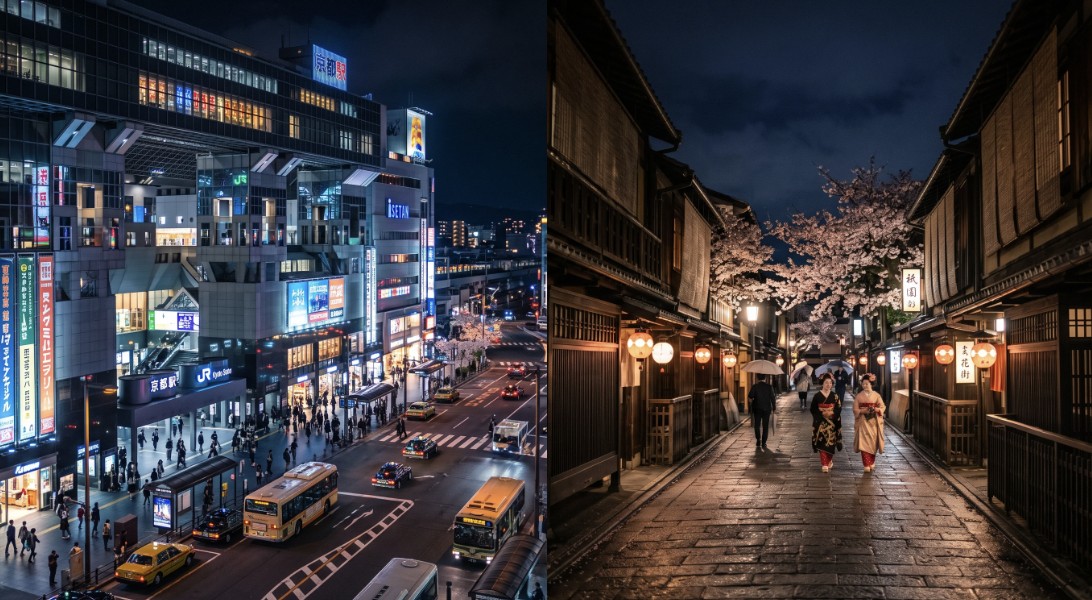
If you want a direct answer to whether Kyoto Station (京都駅) or Gion (祇園) makes the better base for your Kyoto trip, my experience is that Gion is ideal for days packed with culture, traditional scenery, and walking to the main attractions. Kyoto Station works better for convenient access to public transport, shopping, and day trips across Kansai.
Kyoto Station and Gion offer very different bases for a stay in Kyoto. Kyoto Station is generally more practical for rail travel, airport transfers and journeys beyond Kyoto, while Gion suits visitors who want to stay close to historic streets, Yasaka Shrine and southern Higashiyama.
Neither area is automatically better. The right choice depends on your itinerary, accommodation preferences, mobility needs and whether you value transport convenience or proximity to Kyoto’s historic eastern districts.
Kyoto Station vs Gion: Quick Comparison
| Factor | Kyoto Station Area | Gion Area |
|---|---|---|
| Best suited to | Rail travel, airport transfers, luggage and regional journeys | Historic streets, southern Higashiyama and evening walks |
| Transport | JR, Shinkansen, subway, city buses and airport rail | City buses, nearby Keihan Railway and walking access to parts of eastern Kyoto |
| Atmosphere | Modern, busy and transport-focused | Historic entertainment district and residential neighbourhood |
| Useful for | Early departures, Kansai Airport arrivals and long-distance rail travel | Visitors prioritising Gion, Yasaka Shrine and nearby Higashiyama sights |
| Important consideration | Further from many eastern Kyoto sights | Requires onward travel for Shinkansen services and direct HARUKA airport trains |
Staying Near Kyoto Station
Kyoto Station is Kyoto’s principal long-distance rail hub. It is served by the Tokaido Shinkansen, JR lines, the Karasuma Subway Line, Kyoto City buses and airport connections. It can be a practical base if your itinerary includes Osaka, Nara, Kobe, Hiroshima or another destination reached by train.
JR-West operates the Kansai-Airport Express HARUKA, which provides direct services between Kansai Airport and Kyoto Station. Check the official JR-West HARUKA information for current timetables, ticket conditions and booking options.
- Useful for travellers arriving at Kansai Airport or departing early by train.
- Convenient for passengers using the Shinkansen or JR lines.
- Practical when travelling with large luggage, as it avoids an additional city-bus journey immediately after arrival.
- Connected to other parts of Kyoto by city bus, subway and taxi.
Kyoto Station is not within walking distance of many eastern Kyoto sightseeing areas. If your trip focuses mainly on Gion, Kiyomizu-dera, Yasaka Shrine and Higashiyama, allow additional travel time each day.
Staying in Gion
Gion is a historic entertainment district around Shijo Street, between the Kamo River and Yasaka Shrine. It is known for traditional townhouses, teahouses, restaurants and Kyoto’s geiko and maiko culture.
Gion can be a convenient base for visiting Yasaka Shrine, Maruyama Park, Hanamikoji Street and parts of southern Higashiyama. Kiyomizu-dera is in the wider Higashiyama area and can be reached on foot or by public transport, depending on your accommodation and preferred route.
- Useful for visitors who want to spend more time around Gion and southern Higashiyama.
- Convenient for evening walks in the central eastern part of Kyoto.
- Close to Gion-Shijo Station on the Keihan Railway.
- Requires onward travel to Kyoto Station for Shinkansen services and direct HARUKA airport trains.
Gion is both a visitor destination and a residential, working neighbourhood. Follow local signs, keep noise down, do not enter private property and do not block roads or pavements for photographs.
The Kyoto City Official Guide to Gion manners asks visitors not to stop, touch, follow or take unauthorised photographs or videos of geiko and maiko. It also advises visitors not to trespass, obstruct streets or create noise for local residents.
Getting Around Kyoto
Kyoto Station is the city’s principal rail hub, while Gion is served by city buses and is close to Gion-Shijo Station on the Keihan Railway. The most convenient route depends on your exact hotel, destination, luggage and time of day.
For current city-bus, subway and sightseeing-bus information, use the Kyoto City Bus and Subway Information Guide. Check your route on the day of travel because services and operating conditions can change.
The Keihan Railway English website provides travel information for journeys between Kyoto, Uji, Osaka and Shiga.
Airport Transfers
Kyoto Station has a direct rail connection from Kansai Airport via the JR-West HARUKA service. This can be especially useful for travellers arriving with luggage or continuing by Shinkansen after reaching Kyoto.
Gion does not have a direct HARUKA station. Travellers staying in Gion normally continue from Kyoto Station by taxi, Kyoto City bus, subway or onward rail connections, depending on the hotel location and time of arrival.
Before travelling, check the JR-West Kansai Airport travel guide and your accommodation’s current directions.
Day Trips and Long-Distance Travel
Kyoto Station is usually the more practical base if you expect to use the Shinkansen frequently or make several long-distance journeys. It provides direct access to the Tokaido Shinkansen and JR services.
Gion can still work well for a Kyoto-focused stay or selected regional trips, particularly when using nearby private railways. Allow time to travel to Kyoto Station when your itinerary requires the Shinkansen or a direct airport train.
If Kyoto is part of a wider trip, see our 7-Day Japan itinerary for Tokyo, Kyoto and Osaka. It provides related planning information for travellers combining these three cities.
Accommodation Considerations
Accommodation prices and availability in Kyoto vary by date, room type, events and demand. Compare current options for your exact travel dates and read cancellation conditions carefully before booking.
- Choose Kyoto Station if transport connections, luggage convenience and early rail departures are your main priorities.
- Choose Gion if proximity to historic streets and southern Higashiyama is more important than being close to the Shinkansen.
- Check the walking route from your accommodation to the nearest station or bus stop before booking.
- Check whether your accommodation has luggage, check-in or late-arrival restrictions.
Cherry blossom season and autumn foliage can increase demand for accommodation. Gion Matsuri takes place throughout July, and dates, events and crowd levels should be checked through the Kyoto City Official Travel Guide before booking.
Sightseeing from Each Area
Gion is particularly useful for visitors who want to explore Yasaka Shrine, Maruyama Park, Hanamikoji Street and the southern Higashiyama area at a slower pace. Kyoto Station is more useful for a transport-focused itinerary, although it is not the closest base for many eastern Kyoto attractions.
For planning visits to Kyoto temples and shrines, see our Japan temple and shrine visit checklist. It offers related planning information on grouping sites by area and checking official opening times.
Which Area Should You Choose?
- Choose Kyoto Station if airport access, Shinkansen travel, regional journeys and luggage convenience are your main priorities.
- Choose Gion if you want to stay near historic streets, Yasaka Shrine and southern Higashiyama, and are comfortable using city transport when needed.
- Consider a split stay if you are arriving or departing by Shinkansen but also want time in Gion and Higashiyama.
Frequently Asked Questions
Is Gion close to Kyoto’s main attractions?
Gion is close to Yasaka Shrine, Maruyama Park and parts of southern Higashiyama. Other Kyoto attractions, including Arashiyama, Fushimi Inari and the Philosopher’s Path, require additional walking, rail or bus travel.
Is Kyoto Station a good base for day trips?
Kyoto Station is a practical base for travellers using JR services or the Shinkansen. It is particularly useful for itineraries that include other Kansai destinations or long-distance rail travel.
Can I travel directly from Kansai Airport to Gion?
There is no direct HARUKA train station in Gion. The HARUKA runs directly to Kyoto Station, after which you need onward transport to your accommodation in Gion.
Should I stay in Gion during Gion Matsuri?
Gion Matsuri takes place throughout July and can affect accommodation demand, transport and crowd levels. Check the Kyoto City Official Travel Guide and your accommodation’s current information before making a booking.