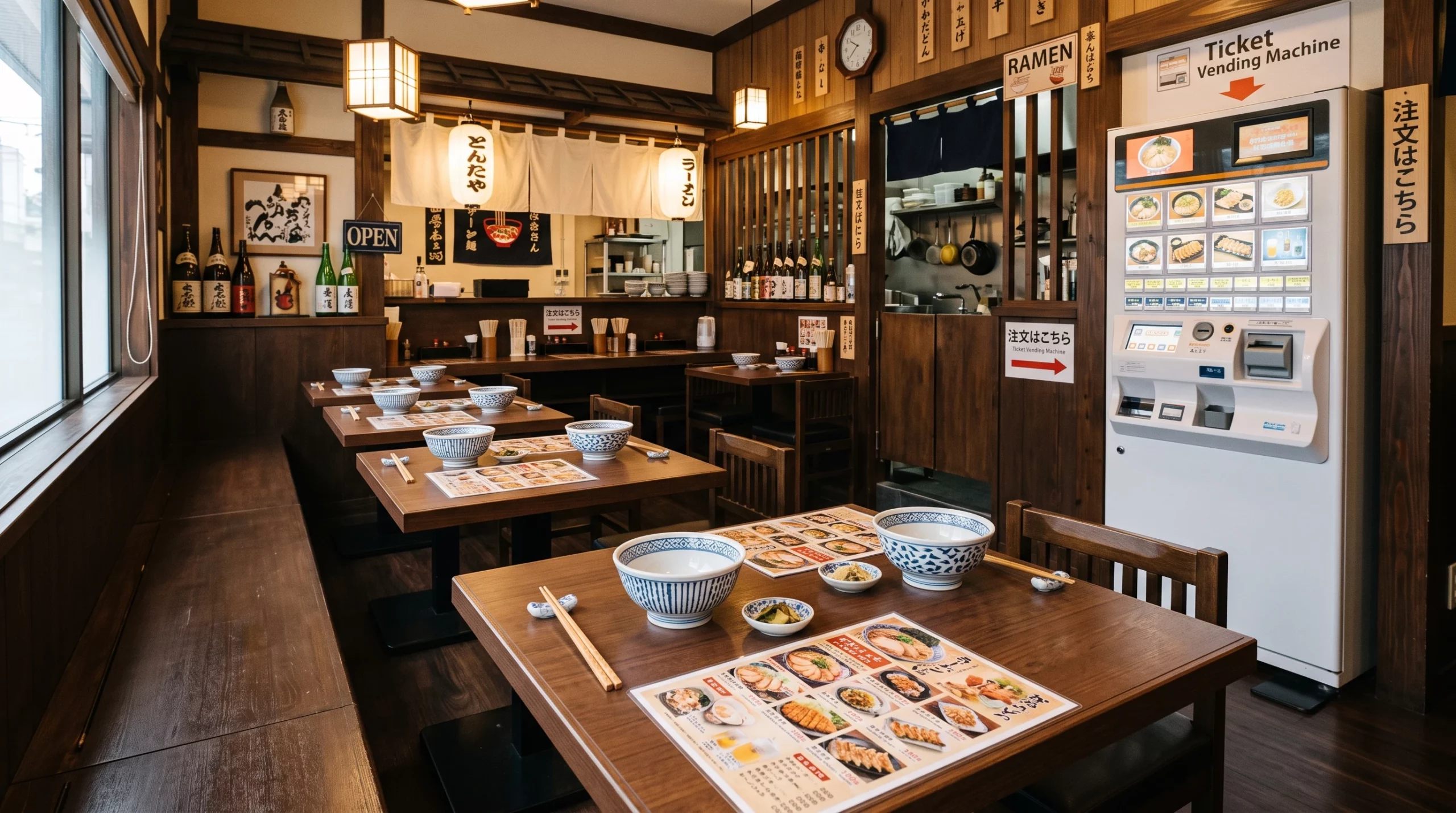
Ordering food at restaurants in Japan is straightforward once you know the basics. Point at the menu, say the item’s name or number, and use key phrases like “sumimasen” (すみません, excuse me) to get a server’s attention. Politeness, patience and a translation app will carry you through most situations, even with no Japanese at all.
For first-time travellers, Japanese dining can feel intimidating because of language barriers and unfamiliar customs. Knowing a few essential tips makes it much easier to read menus, call for service, communicate dietary needs, and pay the bill without any awkward moments.
This guide covers step-by-step advice for ordering food in Japan, including common phrases, how to use English or picture menus, booking tools, and typical payment methods, so you can eat with confidence anywhere from a ramen counter in Tokyo (東京) to a sushi restaurant in Kyoto (京都).
Step 1: Understanding Japan’s Restaurant Types
Japanese restaurants come in many styles. Some use high-tech tablet ordering, some rely on verbal orders, and others use ticket machines at the entrance. Knowing what to expect saves time and reduces confusion.
Common types of Japanese restaurants
- Izakaya (居酒屋): Japanese pubs serving shared small plates and drinks. Usually table service, and calling for staff is completely normal.
- Ramen shops (ラーメン屋): Many use a ticket vending machine at the entrance; you choose and pay before sitting down.
- Kaiten sushi (回転寿司): Conveyor belt sushi. Take plates as they pass or order directly using a tablet at your seat.
- Family restaurants (ファミリーレストラン): Wide menus, often with English options and photos. Servers come to the table to take your order.
- Kaiseki and fine dining (会席料理): Multi-course meals, usually by reservation only, with formal, attentive service.
For further detail on Japanese dining etiquette and what to expect at different restaurant styles, the Japan National Tourism Organization food and drink guide is a reliable official resource worth checking before you eat out.
Step 2: Getting Seated and Calling for Service
When you enter a Japanese restaurant, staff will often greet you with “irasshaimase” (いらっしゃいませ, welcome). A reply is not expected; a smile or small nod is fine. You may be asked how many people are in your group, “nanmei sama desu ka” (何名様ですか), which you can answer by holding up fingers or saying the number in English.
Once seated, servers often will not approach until signalled. Raise your hand and say “sumimasen” (すみません) to get attention; this is standard practice and never considered rude. Some casual restaurants provide call buttons at the table instead.
Key phrases for calling service
- Sumimasen (すみません): Excuse me.
- Menu o onegaishimasu (メニューをお願いします): Menu, please.
- Omizu o kudasai (お水をください): Water, please.
Step 3: Reading Menus and Finding English Options
Menus in Japan range from highly visual, photo-led layouts to menus written entirely in Japanese with little explanation. Many restaurants in tourist areas offer English or picture menus on request; try asking “eigo no menyu wa arimasu ka” (英語のメニューはありますか).
Many restaurants and chains display plastic food replicas (食品サンプル) in the window, making it easy to point at exactly what you want. These displays are a practical ordering tool, not just decoration.
How to order without Japanese
- Point directly at the menu item or food sample.
- Say the number or name of the dish, plus “kudasai” (ください, please).
- Use a translation app such as Google Translate’s camera mode to scan and translate a Japanese menu instantly.
Common menu signs and what they mean
- 今日のおすすめ (kyo no osusume): “Today’s recommendation,” usually a special seasonal dish worth trying.
- 定食 (teishoku): A set meal including a main dish, rice, soup and sides; generally good value.
- 飲み放題 (nomihodai): All-you-can-drink, common in izakaya; always check the time limit before ordering.
- ランチ (ranchi): Lunch menu, typically much cheaper than the same restaurant’s dinner menu.
Many restaurants also print photos of each dish on the menu or display them on the walls, which helps if you are unfamiliar with Japanese food vocabulary.
Step 4: Making Your Order
Ordering food in Japan often involves more subtlety than in the UK. Staff expect politeness, brief exchanges and visual cues such as pointing. A simple approach works well.
- Signal the server when you are ready to order.
- Point at the menu or say the item’s name or number, adding “onegaishimasu” (お願いします, please).
- Make any dietary requests clearly (see below).
- If ordering several items, order them all at once, since it can be difficult to catch a server’s attention again during busy periods.
- Double-check the number of dishes ordered, particularly at sushi or small-plate restaurants where portions are easy to miscount.
Ordering for common dietary requests
- Vegetarian: Ask “bejitarian ryori wa arimasu ka” (ベジタリアン料理はありますか) for vegetarian options, and specify “no meat, fish or dashi” if needed, since many Japanese broths are fish-based.
- Allergies: Learn or show the Japanese word for your allergy in advance. For example, “peanut allergy” is “rakkasei arerugi” (落花生アレルギー).
- No raw food: Say “nama wa tabemasen” (生は食べません) to request only cooked dishes.
Booking platforms such as Klook and Trip.com offer restaurant reservations with English support, which can be genuinely useful for special dietary requests. You can browse Klook’s Tokyo food experiences or use Trip.com’s restaurant reservation service to find English-friendly venues before you travel.
Step 5: Paying at Japanese Restaurants
In Japan, payment is usually made at a dedicated till near the exit, not at the table. Servers will hand you a bill (お会計, okaikei) or a small tray with your order slip; take this to the counter when you are ready to pay.
Cash is widely accepted, especially at smaller restaurants, but card and contactless payments are increasingly common in cities. Digital wallets such as Suica (スイカ), Pasmo (パスモ) and PayPay (ペイペイ) are sometimes accepted, particularly at chain restaurants. UK visitors can set up a Welcome Suica card or app on arrival for easy payments at compatible venues and on public transport.
Official information: Welcome Suica, JR East and Official Japan Travel Planning Hub
Key payment points
- No tipping in Japan: It is not expected or necessary at any type of restaurant.
- Use the small dish or tray provided at the till to hand over cash or a card.
- Splitting the bill (warikan, 割り勘) is common among Japanese diners, but many smaller restaurants prefer one combined payment per table rather than splitting several ways.
If you are unsure whether a restaurant accepts cards, look for card logo stickers at the entrance or ask before ordering. Carrying some cash as backup is sensible, especially outside major cities.
Step 6: Polite Phrases Worth Knowing
A few polite words go a long way, and Japanese staff genuinely appreciate the effort, even if your pronunciation is not perfect.
- Arigatou gozaimasu (ありがとうございます): Thank you.
- Onaka ippai desu (おなかいっぱいです): I’m full.
- Oishii desu (おいしいです): It’s delicious.
- Gochisousama deshita (ごちそうさまでした): Thank you for the meal, said when leaving.
Consider saving a short list of restaurant phrases on your phone before your trip. For further official pre-arrival guidance, the Visit Japan Web portal is a useful government resource to check before you fly.
Step 7: Booking and Language Support Tools
For popular restaurants, particularly in major cities, making a reservation (予約, yoyaku) is often required. Several platforms offer English-language booking, digital menus and allergy information as part of the reservation process.
For menus without English, translation apps such as Google Translate’s camera mode are the most reliable option for explaining ingredients and dish names. Many restaurants also display a QR code at the table for a digital multilingual menu.
Frequently Asked Questions
How do I order food if there’s no English menu?
Point at food samples or menu photos, learn a few basic dish names such as ramen, sushi and donburi in advance, and use a translation app if needed. Most staff will patiently help.
What’s the best way to communicate allergies or dietary needs?
Write your allergy or dietary request in Japanese on paper or your phone, and show it to staff. Be specific, for example “no dashi, no meat,” since Japanese broth often contains fish stock even in seemingly vegetarian dishes.
Can I pay by card or mobile wallet in Japan?
Larger chains and city restaurants usually accept cards. Smaller or more local restaurants often accept cash only. Prepaid IC cards or PayPay may work at chain restaurants, so carry cash as backup.
Is it rude to call for staff with “sumimasen”?
Not at all. “Sumimasen” is the standard, polite way to call for service across Japan. Say it clearly at a normal volume rather than calling out loudly.
Next Steps for Effortless Dining
- Bookmark this guide for reference during your Japan trip.
- Install a translation app and a dining reservation app before you travel.
- Try booking a restaurant through Trip.com or Klook for your first night in Tokyo or Osaka (大阪) to ease into local dining customs.
- Keep a short phrase list handy and review etiquette tips from the JNTO official guide for extra confidence.
Travelling in Japan becomes far smoother once you feel confident ordering food like a local. Bookmark this guide and keep checking back for more step-by-step travel advice across Japan and Asia.