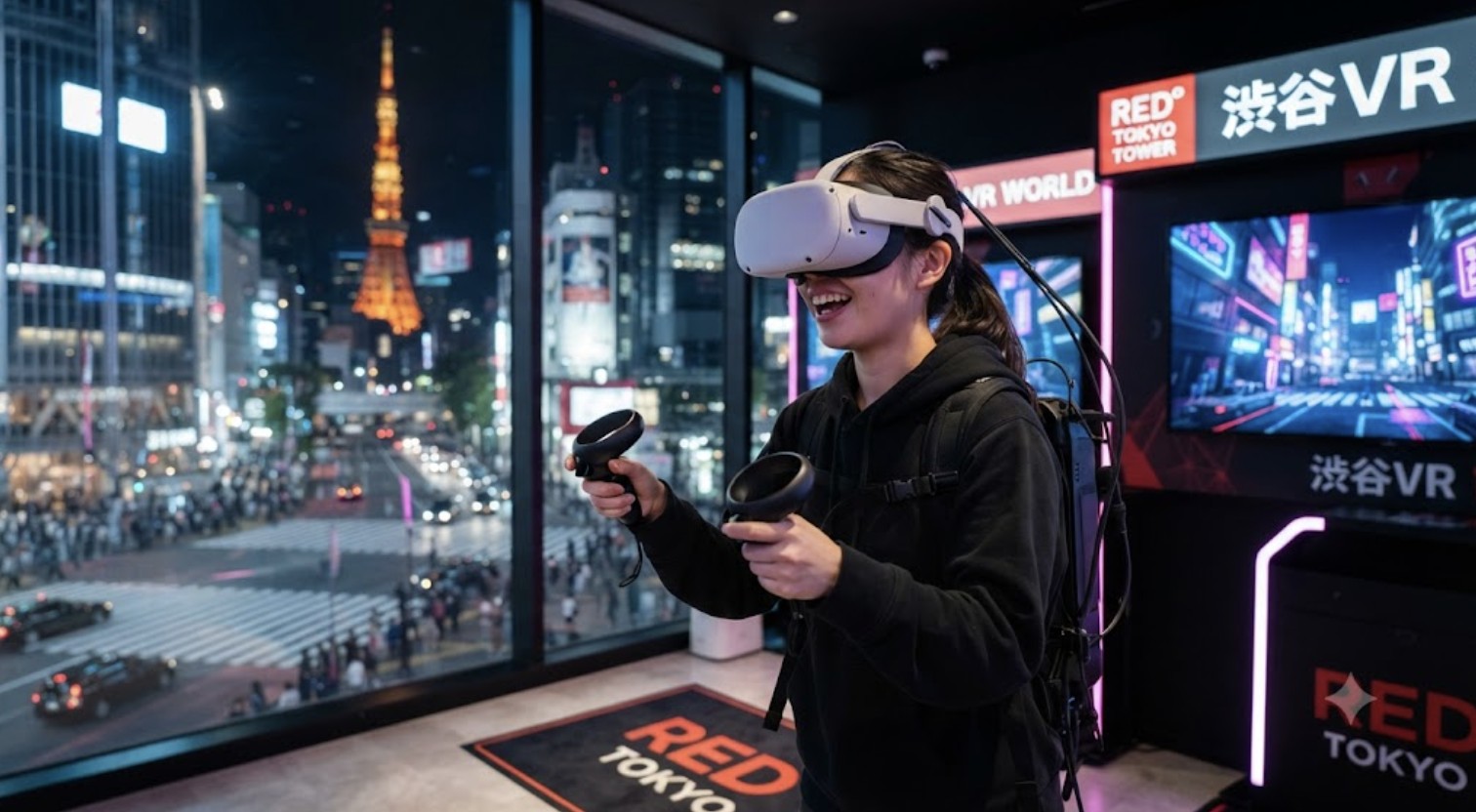
The best virtual reality experiences in Japan are currently concentrated in Tokyo, where TYFFONIUM offers narrative-led headset attractions. For travellers who prefer no headset at all, teamLab’s immersive digital art offers a compelling alternative. Book timed sessions ahead, check the operator’s live restrictions and leave extra time to navigate large entertainment complexes.
Japan is a particularly rewarding place for immersive entertainment because gaming culture extends well beyond the home console. Arcades, themed venues, projection-mapped spaces, motion rides and collaborative games are treated as social experiences. As a result, a great Japan “VR” itinerary should not focus only on wearing a headset. It should also include the broader mix of virtual reality, mixed reality, esports, interactive theatre and digital art that makes Tokyo 東京 feel unlike any other gaming city.
Understand VR, XR and immersive gaming
Virtual reality, usually shortened to VR, places a headset over the eyes and creates a computer-generated environment. Depending on the attraction, you may stand in one position, use hand controllers, walk through a tracked room, ride a motion platform or work with other players. A good VR attraction creates the sense that you have stepped into a different world, whether that world is a fantasy kingdom, horror story, space mission or action game.
Mixed reality and augmented reality are different. Augmented reality layers digital content over what you can see in the real world, while mixed reality blends physical space and virtual elements more deeply. XR is an umbrella term covering VR, AR and mixed reality. Japanese venues sometimes use all of these labels, so do not assume that every experience marketed as “immersive” includes a headset.
This difference affects your booking decision. A 15-minute cinematic headset adventure is not comparable with an all-day esports venue, a puzzle-led live-action game or a digital-art exhibition. Before booking, decide whether you want storytelling, competition, physical movement, social teamwork, photography, or a rainy-day activity that works for everyone in your group.
1. TYFFONIUM: Tokyo’s strongest dedicated VR choice
TYFFONIUM is one of the clearest choices for travellers specifically seeking virtual reality experiences in Japan. The brand combines VR with mixed-reality technology and detailed physical design to create short, story-driven attractions. Rather than feeling like a quick arcade demo, the experience is built around atmosphere: visual worlds, sound, narrative tension and the feeling of being transported somewhere unusual.
Tokyo has TYFFONIUM branches in Shinjuku 新宿 and Odaiba お台場. The Odaiba venue is on the fifth floor of DiverCity Tokyo Plaza, near Daiba Station 台場駅 on the Yurikamome Line and Tokyo Teleport Station 東京テレポート駅 on the Rinkai Line. This makes it easy to combine with Odaiba’s shopping, waterfront scenery, indoor entertainment and the life-size Gundam statue outside DiverCity.
TYFFONIUM Shinjuku is inside Keio Plaza Hotel Tokyo’s South Tower, making it a convenient option for visitors based around Shinjuku Station 新宿駅. Choose Shinjuku if you want to add VR to a central Tokyo sightseeing day, or choose Odaiba if you want a more relaxed waterfront itinerary. Both locations offer a better experience when treated as a timed activity rather than a walk-in afterthought.
Individual story titles, age conditions, permitted group sizes and session availability can change. Some experiences may be horror-themed or unsuitable for people sensitive to motion. Check the attraction description carefully before purchasing, arrive before your booked session, and use the official TYFFONIUM site rather than an old travel blog as the final authority on live availability.
2. Tokyo Joypolis: arcade culture and technology-led rides
Tokyo Joypolis is an indoor Sega amusement park in Odaiba お台場. It should not be marketed as a dedicated VR venue, because its appeal is broader: arcade games, simulator-style rides, motion attractions and technology-led entertainment. For visitors who enjoy Japanese gaming culture, that range can be more satisfying than one headset experience.
Joypolis is a good rainy-day choice and a natural companion to TYFFONIUM Odaiba. It works especially well for rhythm-game fans, ride enthusiasts and visitors who enjoy replaying games to improve a score. Check the live attraction list on the official site before visiting; individual rides, maintenance schedules and health restrictions can change, and not every attraction will suit every member of a family or group.
Motion-based rides may be unsuitable for people with certain medical conditions, severe motion sickness, recent injuries or other restrictions listed by the operator. Read the venue’s attraction rules and choose a calmer activity if necessary. Japan’s best gaming day is one that remains fun rather than one that leaves you unwell before dinner.
3. teamLab: immersive digital art instead of VR
teamLab Borderless and teamLab Planets are frequently grouped with Tokyo VR attractions, but this needs a clear correction: they are immersive digital-art experiences, not conventional headset VR. Visitors move through rooms animated by projection, light, mirrors, sound, water and responsive visuals. The result can feel dreamlike and technologically advanced without the isolation or motion effects of a headset.
Borderless, in Azabudai Hills 麻布台ヒルズ, is an exploratory art museum where works flow between spaces. Planets, in Toyosu 豊洲, is more structured and sensory, with installations that may involve removing shoes or moving through water. Both can be better choices for travellers who want impressive visual immersion but dislike goggles, fast motion or game-like competition.
Timed tickets are often sensible for teamLab, particularly at busy periods.
How to plan a Tokyo immersive-entertainment day
- Allow navigation time: Large Tokyo stations and entertainment complexes take longer to navigate than a map suggests.
- Read restrictions before payment: Confirm age, height, motion-sickness, clothing, mobility, language and group-size rules on the official venue page.
- Keep your schedule flexible: Avoid booking an inflexible meal or train immediately after an attraction, especially if you are visiting on a weekend.
- Use live ticket information: Never rely on an old fixed price, opening hour or game title copied from a third-party article.
Japan travel logistics for VR visitors
Most of the experiences in this guide are easiest to reach by rail. Use Google Maps and Japan Travel by NAVITIME to compare walking routes, train lines and station exits. For a smoother trip, use an IC card where available, keep enough balance for your return journey and screenshot your ticket confirmation before entering an underground station or large complex with patchy signal.
For wider journey planning, use the official Japan travel guide and the Japan National Tourism Organization. Visitors arriving through Narita should check the Narita International Airport official website for transport and terminal information. Complete relevant arrival procedures through the official Visit Japan Web portal before travelling.
If your itinerary includes Hokkaido 北海道 after Tokyo, consult the Hokkaido official tourism portal, the Sapporo official tourism website and JR Hokkaido’s official English website. For weather warnings and earthquake information, bookmark the Japan Meteorological Agency’s English website. Official sources are more dependable than social posts when conditions affect transport or event plans.