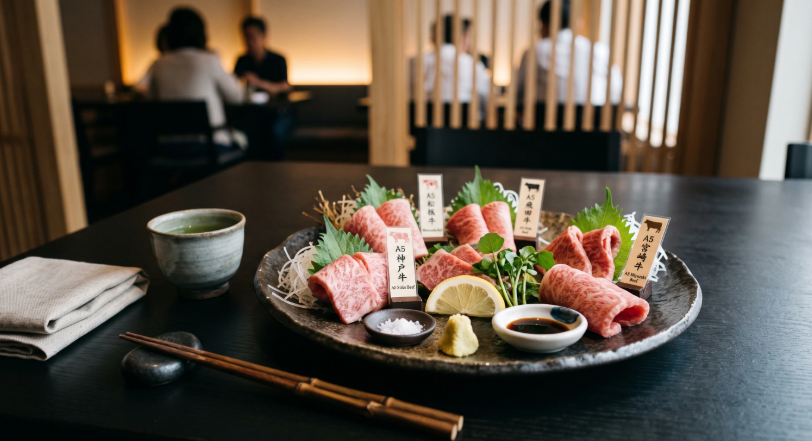
Japan offers some of the world’s finest Wagyu (和牛) beef, with specific regions such as Kobe (神戸), Matsusaka (松阪), and Omi (近江) renowned for their consistently high standards and authentic traditions. Travellers looking for premium Wagyu experiences should focus on these regions and understand the traits that set each area’s beef apart.
Wagyu (和牛) means Japanese cattle. For visitors to Japan, it is useful to distinguish between Wagyu as a broad cattle category and named regional beef brands with their own production and certification standards, such as Kobe beef and Hida beef.
What Is Wagyu?
Japan recognises four Wagyu breeds: Japanese Black, Japanese Brown, Japanese Shorthorn and Japanese Polled. Japanese Black is the breed most commonly associated with highly marbled Japanese beef.
Not all Wagyu is Kobe beef. Wagyu is the broader term, while Kobe beef is a specific certified brand selected from qualifying Tajima cattle under defined standards in Hyogo Prefecture. When ordering, check whether a restaurant is serving a named certified brand or using the general term “Wagyu”.
Understanding Japanese Beef Grades
Japanese beef grading combines a yield grade with a meat-quality grade. Yield is shown by A, B or C, while quality is graded from 1 to 5.
- Yield grade: A, B or C indicates the estimated proportion of usable meat from the carcass.
- Quality grade: Grades 1 to 5 assess marbling, meat colour and brightness, firmness and texture, and fat colour, lustre and quality.
- A5: A5 combines yield grade A with meat-quality grade 5. It is a grading result, not the name of a breed, prefecture, producer or regional Wagyu brand.
Highly marbled beef can be very rich. If you are trying A5 beef or another richly marbled Wagyu for the first time, a modest portion or tasting course may be a more comfortable choice than a large steak.
Certified Kobe Beef in Hyogo
Kobe beef is a tightly controlled brand selected from qualifying Tajima cattle. The Kobe Beef Marketing and Distribution Promotion Association sets the certification standards for beef entitled to use the Kobe beef name.
- Cattle: The animal must be a qualifying Tajima beef heifer or steer.
- Yield and quality: The carcass must receive yield grade A or B and meat-quality grade 4 or above.
- Marbling: It must achieve a Beef Marbling Standard score of 6 or above.
- Carcass weight: The permitted range is 270 kg to 499.9 kg for heifers and 300 kg to 499.9 kg for steers.
- Texture and firmness: The beef must meet the association’s requirements for fine meat texture and excellent firmness.
Officially certified Kobe beef carries the Japanese chrysanthemum mark. Before reserving a restaurant, check that it specifically confirms it serves certified Kobe beef. Terms such as “Kobe-style” and “Kobe Wagyu” do not, by themselves, confirm official Kobe beef certification.
Hida Beef in Gifu
Hida beef is Gifu Prefecture’s branded beef. The Hida Beef Brand Promotion Council certifies it only when it meets requirements for the production area, producer accreditation, rearing period, yield and meat quality.
- Production area: Gifu Prefecture must be the area where the cattle were fattened for the longest period.
- Producer requirement: The cattle must be fattened by a producer certified and registered under the Hida Beef Brand Promotion Council’s farmer accreditation system.
- Breed and rearing period: The beef must come from a black-haired Japanese Wagyu cattle breed fattened for at least 14 months.
- Yield grade: The carcass must receive yield grade A or B.
- Meat-quality grade: The meat must receive Japan Meat Grading Association quality grade 3, 4 or 5.
Certified Hida beef is issued with a Hida beef label. The label lists the meat grade, the producer’s name and address, an individual identification number and the certification date. It is a regional speciality to look for when visiting Gifu Prefecture, including Takayama and the wider Hida area.
Miyazaki Wagyu in Kyushu
Miyazaki Prefecture is an important Wagyu-producing area in Kyushu. At the 12th National Competitive Exhibition of Wagyu, held in Kagoshima Prefecture from 6 to 10 October 2022, Miyazaki Prefecture received the Prime Minister’s Award in the beef-cattle section for the fourth consecutive competition.
The event is often called the “Wagyu Olympics”. Miyazaki’s award followed a top honour in Division 7, the fat-quality evaluation group. This was a significant achievement for the prefecture’s cattle industry, but it is not a permanent ranking of every Wagyu brand, producer or restaurant in Japan.
Choosing an Authentic Wagyu Meal
A regional Wagyu brand is meaningful only when the restaurant can confirm the precise beef it serves. Check the restaurant’s official website before reserving, particularly for its current address, opening hours, reservation process and menu information.
- Ask whether the beef is certified Kobe beef, Hida beef or another named regional brand rather than relying on generic “Wagyu” wording.
- For richly marbled beef, ask which cut and portion size the restaurant recommends for the cooking style you have chosen.
- Check the restaurant’s current cancellation policy and reservation requirements before booking.
- Tell the restaurant about allergies and dietary requirements before booking. Do not assume that every requirement can be accommodated.
Common Ways to Eat Wagyu
- Steak: Thick-cut beef, commonly served at specialist steak and teppanyaki restaurants.
- Teppanyaki: Beef cooked on an iron griddle, sometimes prepared by a chef in front of diners.
- Yakiniku: Small cuts of beef grilled at the table, allowing diners to control the cooking time.
- Sukiyaki: Thinly sliced beef simmered with a sweet-savoury seasoning, vegetables and tofu.
- Shabu-shabu: Thinly sliced beef briefly swished in hot broth before being dipped in sauce.
Can You Bring Wagyu Home?
Travellers arriving in Great Britain from Japan must not bring meat or meat products in their personal luggage. This includes fresh, cooked, cured and packaged beef products.
Check the latest UK Government guidance on bringing food into Great Britain before buying food gifts. Import requirements can change, and prohibited food products may be seized at the border.
Frequently Asked Questions
Is all Wagyu Kobe beef?
No. Wagyu is the broad term for Japanese cattle breeds. Kobe beef is a specific certified brand selected from qualifying Tajima cattle under defined standards.
What does A5 mean?
A5 combines yield grade A with the highest meat-quality grade, 5. It does not identify the prefecture, cattle breed, producer or regional beef brand.
How can I identify certified Kobe beef?
Officially certified Kobe beef carries the Japanese chrysanthemum mark. Check the Kobe Beef Marketing and Distribution Promotion Association’s information and ask the restaurant to confirm that it serves certified Kobe beef.
Can I bring Japanese Wagyu back to Scotland?
No. Travellers arriving in Great Britain from Japan cannot bring meat or meat products for personal use. Check current UK Government guidance before travelling.