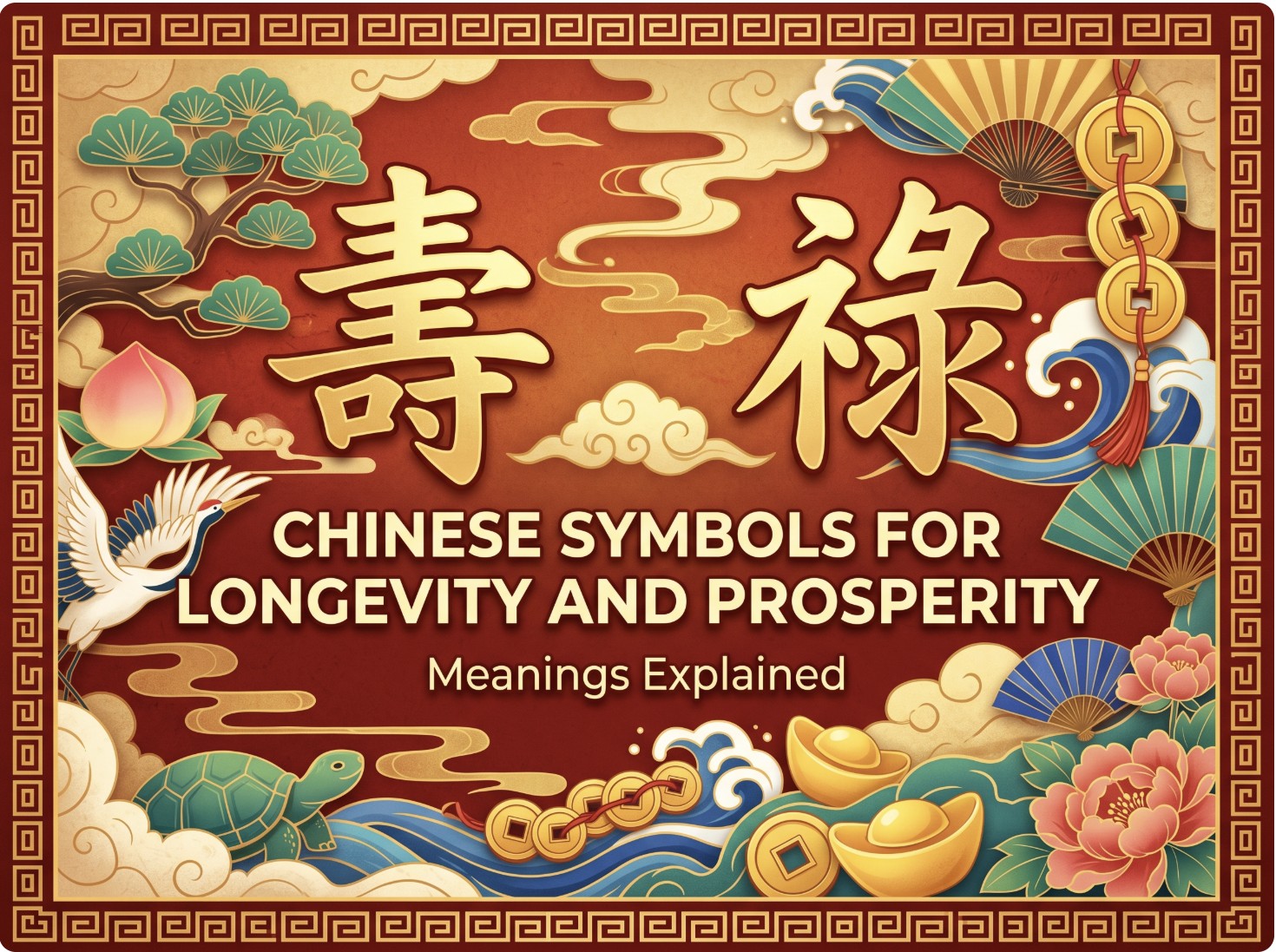
Chinese art, celebrations and decorative objects often use auspicious symbols to express wishes for a long life, happiness, abundance, success and family well-being. Chinese symbols for longevity and prosperity include the character 寿 / 壽 (shòu, longevity), peaches, pine trees, cranes, deer, fish, coins, gold or silver ingots, and peonies. Their meanings can vary by historical period, region, religion and the combination of motifs used together, but they remain recognisable cultural expressions of good wishes.
It is helpful to view these motifs as visual blessings rather than fixed superstitions. In Chinese art, a flower, animal, object or character may carry meaning through its appearance, a traditional story, or a wordplay based on similar-sounding Chinese words. A single design can also communicate several wishes at once: for example, long life, wealth, harmony and success.
Why Symbolism Is Important in Chinese Culture
Auspicious imagery has appeared for centuries on paintings, ceramics, furniture, textiles, jewellery, architecture and New Year decorations. These images were particularly appropriate for birthdays, weddings, Lunar New Year celebrations, housewarmings and other important life events. They may still be used today in homes, businesses, red envelopes, festive decorations and gifts.
Many symbolic meanings are based on rebus imagery: a picture refers to a word that sounds similar to another word with an auspicious meaning. This is especially common in Mandarin, although pronunciations and wordplay can differ in Cantonese and other Chinese languages. For this reason, a symbol should be interpreted with care and in context rather than treated as having one identical meaning everywhere.
Chinese Symbols of Longevity
Longevity is one of the most valued traditional blessings. It is commonly expressed through the character 寿 in simplified Chinese, or 壽 in traditional Chinese. Both are pronounced shòu in Mandarin and mean long life or longevity. In decorative art, the character can appear in many stylised forms, sometimes arranged in round patterns or repeated across textiles and ceramics for birthday celebrations.
| Symbol | Chinese name | Traditional association |
|---|---|---|
| Shou character | 寿 / 壽 (shòu) | Longevity and wishes for a long life |
| Peach | 桃 (táo) | Immortality and long life in Daoist tradition |
| Pine tree | 松 (sōng) | Endurance, constancy and longevity |
| Crane | 鹤 / 鶴 (hè) | Long life, transcendence and the realm of immortals |
| Deer | 鹿 (lù) | Longevity in art and a wordplay linked with official emolument or prosperity |
| Lingzhi fungus | 灵芝 / 靈芝 (língzhī) | Immortality, longevity and wishes fulfilled |
The Shou Character: 寿 / 壽
The Shou character is the most direct Chinese symbol of longevity. It is widely found on birthday gifts, porcelain, robes, furniture, red decorations and calligraphy. A stylised version may be difficult to read at first, because artists have created many decorative forms over time. Its message is nevertheless straightforward: a wish that the recipient enjoys a long and fulfilling life.
In traditional art, Shou may appear alongside peaches, cranes, pine trees or the God of Longevity. These combinations reinforce the long-life message. It is appropriate to see Shou decoration on birthday goods, but it is not a substitute for knowing the recipient’s taste; a thoughtfully chosen, culturally appropriate gift is always preferable to selecting an object purely for its supposed symbolism.
Peaches and the Wish for Long Life
Peaches are among the best-known Chinese longevity motifs. Their association with long life is connected with Daoist stories of Xiwangmu (西王母), often translated as the Queen Mother of the West. In these traditions, peaches associated with her garden are linked with immortality. As a result, peach imagery appears frequently in birthday art, ceramics and celebratory foods.
Peach-shaped birthday buns, often called shoutao (寿桃), are a familiar example. They are usually steamed buns shaped and coloured to resemble peaches, rather than actual peaches. They are served as a celebratory wish for a long life, particularly at milestone birthdays and family gatherings.
Pine Trees
The evergreen pine represents endurance and longevity because it remains green through winter. Pine is also one of the Three Friends of Winter (岁寒三友 / 歲寒三友): pine, bamboo and plum blossom. Together, these plants are associated with resilience and admired moral qualities, especially in traditional scholar culture.
A pine tree may be shown with cranes, deer or a longevity character in paintings and decorative designs. The combination of pine and crane is particularly recognisable as a wish for long life. In some contexts, paired cranes and pine may also express wishes for a long and harmonious marriage.
Cranes
Cranes are associated with longevity, elegance and the world of immortals in Chinese visual culture. Their white feathers could evoke the white hair of old age, while Daoist imagery often shows cranes as mounts or companions of immortals. Cranes therefore appear frequently in paintings and objects made for birthday celebrations.
The crane should not be treated as a general symbol of wealth. Its strongest traditional association is long life, elevated status and transcendence. When you see a crane in a design, look at the accompanying images: a peach, pine tree, cloud or Shou character can make the intended longevity message more explicit.
Deer
The deer is a layered symbol. It may appear with Shoulao, the God of Longevity, and can therefore take part in a longevity design. At the same time, the Chinese word for deer, 鹿 (lù), sounds like 禄 / 祿 (lù), a term historically associated with official salary, emolument and career success. This wordplay gives the deer an additional association with prosperity and advancement.
That double meaning explains why deer can appear in both longevity and prosperity imagery. It is better described as a symbol that can convey more than one auspicious wish, rather than as an automatic promise of wealth or long life.
Shoulao, the God of Longevity
Shoulao (寿老), also known as Shouxing (寿星), is a popular deity of longevity. He is often depicted as an elderly man with a high forehead, a long beard and a peach. In art, he may be shown with a deer or crane. These attributes make him easy to recognise in traditional paintings, ceramics and birthday decorations.
Shoulao represents a cultural wish for long life and is linked with the southern star Canopus in traditional beliefs. His image is especially relevant to birthday iconography. However, religious practice and personal belief vary widely, so visitors should treat devotional images with respect rather than using them merely as novelty decorations.
The Eight Immortals and Their Attributes
The Eight Immortals (八仙, Bāxiān) are well-known figures in Daoist tradition. They are often represented either as figures or through their identifying objects, known collectively as the Eight Treasures. Their images may appear in art as a general wish for good fortune, protection and blessings, rather than as a single symbol with one narrow meaning.
- Li Tieguai (李铁拐 / 李鐵拐): an iron crutch and gourd.
- Han Zhongli (汉钟离 / 漢鍾離): a feather fan.
- Zhang Guolao (张果老 / 張果老): a fish drum or bamboo tube drum.
- Lü Dongbin (吕洞宾 / 呂洞賓): a sword.
- He Xiangu (何仙姑): a lotus flower.
- Lan Caihe (蓝采和 / 藍采和): a flower basket.
- Han Xiangzi (韩湘子 / 韓湘子): a flute.
- Cao Guojiu (曹国舅 / 曹國舅): castanets or court tablets.
Because the Eight Immortals have religious and cultural significance, images of them should be approached thoughtfully. Their attributes are useful for identifying traditional art, but meanings can differ according to the full scene, period and place where the work was made.
Chinese Symbols of Prosperity and Abundance
Prosperity in Chinese symbolism can refer to wealth, surplus, a flourishing household, career success and good fortune. Common motifs include fish, coins, ancient ingots, peonies and the characters 福 (fú, good fortune), 禄 / 祿 (lù, prosperity or official emolument), and 财 / 財 (cái, wealth). Each has a specific nuance, so they should not all be translated simply as “money”.
Fish: Surplus and Plenty
Fish are a major auspicious motif because the Mandarin word for fish, 鱼 / 魚 (yú), sounds like the word for surplus or abundance, 余 / 餘 (yú). A well-known Lunar New Year greeting, 年年有余 / 年年有餘 (niánnián yǒu yú), expresses the wish to have a surplus year after year.
Fish designs can therefore express abundance and the hope that a household has more than enough. A pair of fish may add associations of harmony, fertility or marital happiness, depending on the context. Carp are also linked with perseverance and success through the story of the carp leaping over the Dragon Gate.
Coins and Ancient Ingots
Ancient Chinese cash coins, recognised by their round shape and square central hole, are direct symbols of wealth and commerce. They are commonly depicted in groups or tied with red cord in festive decorations. Their historical design has made them a familiar visual shorthand for money and prosperity.
Yuanbao (元宝 / 元寶) are boat-shaped ingots used as symbols of wealth in New Year imagery and decorative art. They are often called gold ingots in everyday English, although historical ingots could be made from different precious metals. In symbolic art, the important point is their association with riches and good fortune, not the material of a particular object.
Peonies: Wealth, Honour and Beauty
The peony, 牡丹 (mǔdān), is traditionally associated with wealth, honour, beauty and high social standing. Its full blooms made it a popular subject in Chinese painting and decorative arts. A peony motif can be an elegant choice for a celebratory gift or home decoration, particularly when the intended message is prosperity combined with grace and happiness.
Peonies are not interchangeable with every other flower in Chinese symbolism. For example, lotus often conveys purity and harmony, while chrysanthemum is associated with autumn and can also carry longevity associations. Identifying the flower correctly matters when interpreting Chinese art.
The Fu, Lu and Shou Blessings
The three characters 福禄寿 in simplified Chinese, or 福祿壽 in traditional Chinese, are read as fú, lù, shòu in Mandarin. Together, they express three traditional wishes for a good life: good fortune, prosperity or success, and longevity.
Fu (福) refers to blessings, good fortune and happiness. Lu (禄 / 祿) originally had a connection with an official’s salary, rank and career success, so it carries associations of prosperity, status and advancement. Shou (寿 / 壽) means longevity. The three characters may appear together in calligraphy, festive decorations, ceramics, paintings and household ornaments.
Fu, Lu and Shou can also be represented as the Three Star Gods, known as Sanxing (三星), or the Three Stars. Their figures are common in traditional religious and decorative art. The characters themselves are also widely used without the deity figures, especially in designs intended to express blessings for a home, family or celebration.
Other Auspicious Chinese Symbols
Chinese symbolism is broad and context matters. The same animal, plant or object can carry several meanings depending on the words, characters and images placed around it. The following motifs are also widely associated with positive wishes in Chinese decorative culture.
- Bat: The word for bat, 蝠 (fú), sounds similar to 福 (fú), meaning good fortune. Bats are therefore auspicious in traditional decorative art, despite their very different associations in some Western cultures.
- Lotus: The lotus, 莲 / 蓮 (lián), is often associated with purity because it grows from muddy water while producing a clean flower. It can also express harmony and continuity through Chinese wordplay.
- Mandarin oranges: Mandarin oranges are commonly exchanged or displayed during Lunar New Year celebrations. Their golden colour and auspicious word associations make them popular symbols of wealth and good fortune.
- Bamboo: Bamboo is associated with resilience, integrity and flexibility. Alongside pine and plum blossom, it forms the Three Friends of Winter.
- Dragon: The Chinese dragon is associated with power, vitality, rainfall and imperial authority. It is an auspicious cultural symbol, but its exact meaning depends strongly on the historical context and how it is depicted.
- Double Happiness: The character 囍 (shuāngxǐ) combines two instances of 喜, meaning happiness or joy. It is especially associated with weddings and marriage celebrations.
How These Symbols Are Used Today
Traditional Chinese symbols remain visible in modern Chinese communities around the world. You may see the Shou character on birthday decorations, fish and coin designs during Lunar New Year, peonies in art and gift packaging, and the Double Happiness character at wedding celebrations. These motifs can appear in highly traditional forms or in modern graphic designs.
Symbols are often chosen to suit a particular occasion. The Shou character, peaches and cranes are especially appropriate for birthday wishes. Double Happiness is intended for weddings. Fu characters, red decorations, coins and fish motifs are widely used around Lunar New Year to express wishes for good fortune and abundance in the year ahead.
When choosing a gift or decoration inspired by Chinese symbolism, consider the recipient and the occasion. A meaningful design should be selected respectfully, particularly where an image has religious or ceremonial significance. If you are unsure, choose a clearly decorative item and focus on the good wishes represented by the symbol.
Final Thoughts
Chinese symbols for longevity and prosperity create a rich visual language of good wishes. The Shou character, peaches, cranes, pine trees and Shoulao are closely associated with long life. Fish, coins, ingots, peonies and the Lu character can express abundance, wealth, honour or career success.
The deer is especially interesting because it can connect both longevity and prosperity. It appears in longevity imagery with Shoulao, while the Mandarin word for deer, lù, sounds like the word 禄 or 祿, which has traditional associations with official salary, status and prosperity.
The most useful way to understand Chinese symbols is to consider the full context. Artists often combine several characters, animals, flowers and objects to express wishes for long life, happiness, prosperity, harmony and good fortune at the same time. These motifs continue to add cultural depth to Chinese art, celebrations and everyday life.
Frequently Asked Questions
- What is the Chinese symbol for longevity? The Chinese character for longevity is 寿 in simplified Chinese and 壽 in traditional Chinese. Both are pronounced shòu in Mandarin.
- What do Fu, Lu and Shou mean? Fu (福) means good fortune or blessings. Lu (禄 or 祿) is associated with prosperity, career success and status. Shou (寿 or 壽) means longevity.
- Why are fish a Chinese symbol of prosperity? The Mandarin word for fish, 鱼 or 魚 (yú), sounds like the word for surplus or abundance, 余 or 餘 (yú). Fish therefore express the wish for abundance year after year.
- Why is the deer a Chinese symbol of prosperity? The word for deer, 鹿 (lù), sounds like 禄 or 祿 (lù), a term historically associated with official salary, rank and prosperity. Deer can also appear in images connected with longevity.