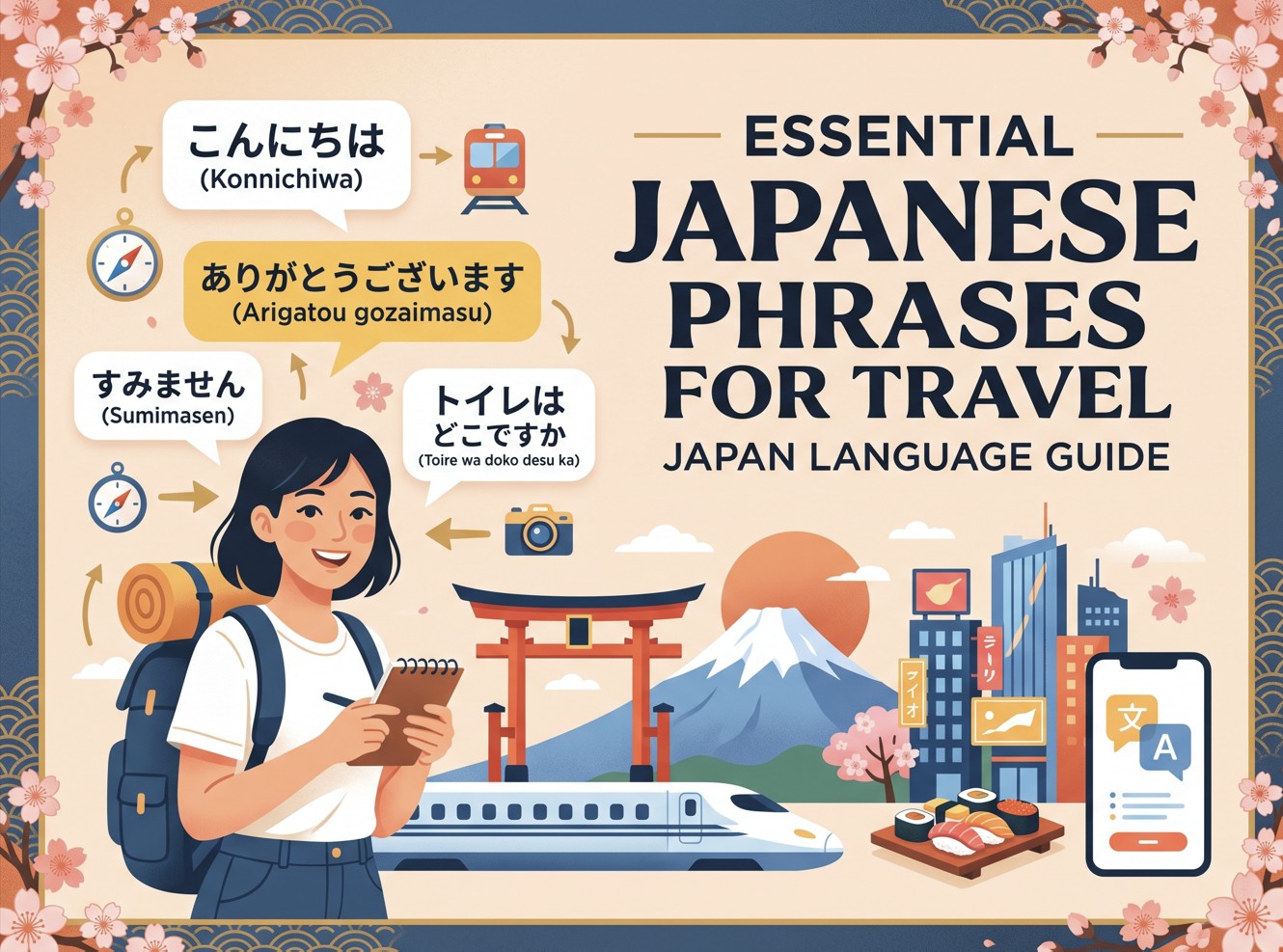
Travelling in Japan without speaking Japanese can feel daunting at first, but a small set of practical phrases can make everyday situations easier. Learning how to greet someone, ask for help, order food, check a price and explain that you do not understand can help you travel more confidently and politely.
You do not need to master Japanese grammar before your trip. Focus on phrases you are likely to use, practise listening as well as speaking, and keep a written or saved phrase list on your phone for moments when you need extra help.
Why Learn Basic Japanese for Travel?
English signs, translated menus and multilingual ticket machines are common in many major tourist areas, but they are not available everywhere. Basic Japanese can be helpful at smaller restaurants, local shops, rural stations, clinics and accommodation where English communication may be limited.
Even a few polite phrases can make interactions clearer. The goal is not perfect pronunciation or fluent conversation; it is to communicate your immediate need respectfully and understand the next practical step.
- Ask where a station, toilet, hotel or attraction is located.
- Order food by pointing to a menu item and using a simple phrase.
- Ask how much something costs or whether card payment is accepted.
- Explain that you do not understand and ask someone to speak slowly.
- Use basic phrases when seeking medical, police or other emergency help.
What to Learn Before You Go
Build your phrase list around the situations in your itinerary. A city break may require transport, restaurant and shopping phrases, while a countryside itinerary may make directions, accommodation and emergency vocabulary more important.
| Situation | Useful language goal | Example phrase |
|---|---|---|
| Greetings | Start politely and thank people | ありがとうございます (Arigatō gozaimasu) – Thank you very much |
| Directions | Ask where a place is | 駅はどこですか? (Eki wa doko desu ka?) – Where is the station? |
| Transport | Check whether a train goes to your destination | この電車は新宿に行きますか? (Kono densha wa Shinjuku ni ikimasu ka?) – Does this train go to Shinjuku? |
| Food | Order by pointing to an item | これをください。 (Kore o kudasai.) – This one, please |
| Shopping | Ask the price | いくらですか? (Ikura desu ka?) – How much is it? |
| Help | Explain that you do not understand | わかりません。 (Wakarimasen.) – I do not understand |
Japanese Pronunciation Basics
Japanese has five main vowel sounds. Romanised spellings are useful as a memory aid, but listening to native audio is the best way to learn the rhythm and sound of each phrase.
- A / あ: similar to “ah”, as in “father”.
- I / い: similar to “ee”, as in “see”.
- U / う: similar to “oo”, as in “food”, but usually shorter and less rounded.
- E / え: similar to “eh”, as in “bed”.
- O / お: similar to “oh”.
Pronounce syllables clearly and at an even pace rather than trying to imitate an English-style stress pattern. Long vowels and doubled consonants can change a word’s meaning, so listen closely to the audio for a phrase rather than relying only on romanisation.
Essential Japanese Travel Phrases
The phrases below use polite, practical wording suitable for travellers. You can copy them into a phone note, save screenshots, or make your own flashcards before departure.
Greetings and Politeness
| Japanese | Romanisation | Meaning |
|---|---|---|
| おはようございます | Ohayō gozaimasu | Good morning |
| こんにちは | Konnichiwa | Hello / good afternoon |
| こんばんは | Konbanwa | Good evening |
| ありがとうございます | Arigatō gozaimasu | Thank you very much |
| すみません | Sumimasen | Excuse me; sorry; may I get your attention? |
| お願いします | Onegaishimasu | Please; used when making a polite request |
| わかりません | Wakarimasen | I do not understand |
| ゆっくりお願いします | Yukkuri onegaishimasu | Slowly, please |
Transport and Directions
| Japanese | Romanisation | Meaning |
|---|---|---|
| 駅はどこですか? | Eki wa doko desu ka? | Where is the station? |
| トイレはどこですか? | Toire wa doko desu ka? | Where is the toilet? |
| この電車は新宿に行きますか? | Kono densha wa Shinjuku ni ikimasu ka? | Does this train go to Shinjuku? |
| 切符を一枚ください。 | Kippu o ichimai kudasai. | One ticket, please |
| ここで降ります。 | Koko de orimasu. | I get off here |
| 地図を見せてもらえますか? | Chizu o misete moraemasu ka? | Could you show me a map? |
Food and Drink
| Japanese | Romanisation | Meaning |
|---|---|---|
| これをください。 | Kore o kudasai. | This one, please |
| おすすめは何ですか? | Osusume wa nan desu ka? | What do you recommend? |
| 英語のメニューはありますか? | Eigo no menyū wa arimasu ka? | Do you have an English menu? |
| お水をお願いします。 | Omizu o onegaishimasu. | Water, please |
| お会計をお願いします。 | Okaikei o onegaishimasu. | The bill, please |
| とてもおいしいです。 | Totemo oishii desu. | It is very delicious |
Shopping and Accommodation
| Japanese | Romanisation | Meaning |
|---|---|---|
| いくらですか? | Ikura desu ka? | How much is it? |
| カードは使えますか? | Kādo wa tsukaemasu ka? | Can I use a card? |
| Wi-Fi はありますか? | Wai-fai wa arimasu ka? | Is there Wi-Fi? |
| 予約しています。 | Yoyaku shite imasu. | I have a reservation |
| チェックインをお願いします。 | Chekkuin o onegaishimasu. | I would like to check in, please |
| 荷物を預けられますか? | Nimotsu o azukeraremasu ka? | Can I leave my luggage here? |
Language Help and Emergencies
For serious emergencies, call the emergency services rather than relying on a phrasebook. In Japan, call 110 for police and 119 for ambulance or fire services. The JNTO Japan Visitor Hotline is also available 24 hours a day for tourist information and emergency assistance in English, Chinese and Korean.
| Japanese | Romanisation | Meaning |
|---|---|---|
| 英語を話せますか? | Eigo o hanasemasu ka? | Can you speak English? |
| 助けてください。 | Tasukete kudasai. | Please help me |
| 病院はどこですか? | Byōin wa doko desu ka? | Where is the hospital? |
| アレルギーがあります。 | Arerugī ga arimasu. | I have an allergy |
| 救急車を呼んでください。 | Kyūkyūsha o yonde kudasai. | Please call an ambulance |
| 警察を呼んでください。 | Keisatsu o yonde kudasai. | Please call the police |
Important allergy advice: “Arerugī ga arimasu” only tells someone that you have an allergy; it does not identify the trigger. Carry a written allergy card in Japanese that states the exact allergens and the seriousness of your reaction. Confirm ingredients directly with the restaurant or food provider, and do not rely on verbal reassurance alone.
How to Learn and Practise
A short, regular routine is more useful than trying to learn a large amount of vocabulary in one session. Choose a small set of phrases, hear them spoken by a reliable source, repeat them aloud, then practise using them in a realistic travel scenario.
| Method | Best use | Practical tip |
|---|---|---|
| Official phrase lists | Reliable core travel language | Save a JNTO phrase list for quick reference |
| Language-learning apps | Short daily practice and basic vocabulary | Use the audio feature; do not rely on reading alone |
| Flashcards or phone notes | Memorising high-priority phrases | Create cards based on your own itinerary |
| Online tutor or language exchange | Pronunciation and conversation practice | Practise hotel, restaurant and transport roleplays |
| Translation app | Back-up help with written Japanese | Download Japanese for offline use before departure |
- Practise a greeting, one request and one question each day.
- Speak phrases aloud rather than memorising them silently.
- Use place names from your itinerary, such as Tokyo, Kyoto, Osaka or the name of your hotel.
- Prepare screenshots of key phrases in Japanese in case your phone signal is poor.
- Download an offline translation pack and store your hotel address in Japanese before arrival.
Speaking with Confidence
Speak slowly, use short sentences and point to a map, menu or written address when useful. If someone does not understand, try a simpler phrase rather than repeating the same sentence more loudly or more quickly.
- Begin with “sumimasen” to politely get someone’s attention.
- Use “kore o kudasai” while pointing to an item to order clearly.
- Say “wakarimasen” if you do not understand, followed by “yukkuri onegaishimasu” to ask the person to speak slowly.
- Show a saved Japanese address to taxi drivers, hotel staff or station workers instead of trying to pronounce every detail.
- Thank staff with “arigatō gozaimasu” after they help you.
Frequently Asked Questions
Do I need to speak Japanese to visit Japan?
No. Many visitors travel successfully without speaking Japanese, especially in major cities. However, basic phrases, translation tools and written addresses can make everyday travel easier and reduce misunderstandings.
What is the most useful Japanese phrase for travellers?
“Sumimasen” is one of the most useful phrases because it can politely mean “excuse me”, “sorry” or “may I have your attention?”. Pair it with pointing, a map or a written phrase when you need help.
How do I ask whether someone speaks English?
Say “Eigo o hanasemasu ka?” (英語を話せますか?), meaning “Can you speak English?”. If the answer is no, try a translation app, point to the relevant information, or use a short written phrase.
How should I handle a food allergy in Japan?
Prepare a detailed written allergy card in Japanese that names each allergen and explains the severity of the reaction. Speak to the food provider directly, check ingredient information carefully, and avoid foods when you cannot confirm they are safe.
What emergency numbers should I save before visiting Japan?
Save 110 for police and 119 for fire or ambulance services. You can also save the JNTO Japan Visitor Hotline: +81 50-3816-2787, available 24 hours a day, 365 days a year.
Official Resources
- JNTO: Japanese language phrases for travellers
- JNTO: Medical and emergency assistance information
- Japan National Tourism Organization
- UK Government travel advice: getting help in Japan
Learn a few phrases before you fly, keep the most useful ones saved offline, and use Japanese alongside clear gestures, maps and translation tools. A calm, polite approach is usually more valuable than trying to say too much.