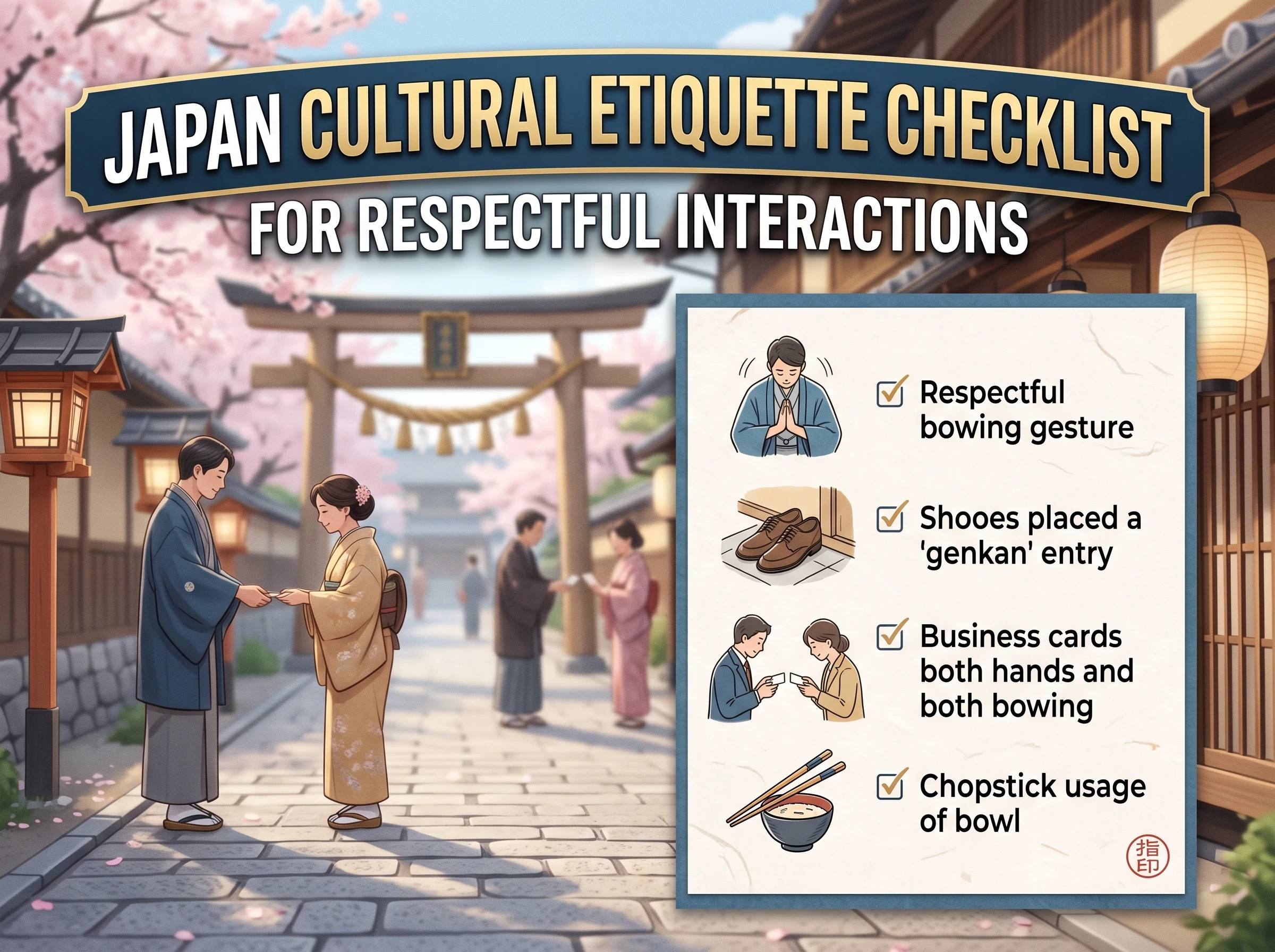
Japan is welcoming to international visitors, and nobody expects a traveller from the UK to know every custom perfectly. The most useful rule is simple: be aware of the people around you, keep noise and disruption to a minimum, and follow signs or staff instructions. A polite apology and willingness to learn will usually matter far more than performing etiquette flawlessly.
The Essential Rule: Consider Others
Respect for others and awareness of one’s surroundings are important in Japan. The Japanese word wa (和) is often translated as harmony, but visitors should not treat it as a strict instruction book for every interaction. It is more useful to understand that public consideration, patience and avoiding unnecessary inconvenience are widely valued.
Etiquette also changes by region, age group, workplace and situation. Tokyo (東京) can feel fast-paced and informal in some settings, while a traditional inn in Kyoto (京都), a rural temple town or a formal business meeting may require a more careful approach. Watch what local people do, read signs, and ask politely if you are unsure.
| Situation | Good practice | Avoid |
|---|---|---|
| Public transport | Keep calls quiet or avoid them, use headphones and let passengers leave first | Loud calls, blocking doors or placing bags on seats |
| Restaurants | Say itadakimasu if you wish, use serving utensils and follow staff guidance | Leaving chopsticks upright in rice or using them to point |
| Shrines and temples | Dress respectfully, follow signs and behave quietly | Entering restricted areas, treating worship spaces as photo props or blocking paths |
| Hotels and ryokan | Remove shoes when asked and follow bathing rules carefully | Wearing outdoor shoes indoors or entering baths without washing first |
| Shopping | Queue patiently and hand over cash or cards neatly when a tray is provided | Trying to bargain in fixed-price shops |
Greetings and Conversation
Bowing is a common Japanese greeting, but visitors do not need to master bow angles or formal techniques. A small nod or slight bow in return is usually enough in ordinary tourist situations. Staff may bow to welcome or thank you; a friendly nod, smile and “arigatou gozaimasu” (ありがとうございます, thank you very much) is an appropriate response.
- Use a person’s family name followed by san (さん) if you know it, for example “Tanaka-san”.
- Use first names only when invited to do so or when dealing with friends in an informal setting.
- A handshake may happen in international business settings, but wait for the other person to initiate it.
- Do not worry excessively about eye contact. Natural, relaxed eye contact is fine; prolonged staring can feel uncomfortable in any culture.
- Physical affection in public is generally more restrained than in the UK, particularly with people you have just met.
Japanese communication can sometimes be indirect, especially when declining a request. Phrases such as “that may be difficult” can mean “no”. Avoid pressing staff, hosts or colleagues for a more direct answer when they have already indicated that something cannot be arranged.
Public Transport Etiquette
Japan’s rail network is efficient, busy and generally orderly. On trains, metros and buses, keep your voice low, use headphones at a volume only you can hear, and avoid phone calls where possible. Many commuters rest, read or use their phones quietly, so an enthusiastic group conversation can stand out more than it would on a UK train.
- Queue where platform markings indicate and allow passengers to leave before boarding.
- Move into the carriage after boarding so you do not block the doorway.
- Set your phone to silent or vibrate mode; avoid calls on the train unless there is an urgent reason.
- Offer priority seats to older passengers, pregnant passengers, passengers with disabilities and people travelling with infants.
- Keep rucksacks off your back in crowded spaces and do not place luggage on seats.
- On escalators, follow the local flow shown by signs. Customs differ between regions, so do not assume Tokyo and Osaka use the same side.
On the Shinkansen (新幹線), eating a packed meal or ekiben (駅弁) is normal, particularly on longer journeys. Take your rubbish with you or use the bins provided, and keep food smells and noise considerate of nearby passengers.
Dining and Chopsticks
Japanese restaurants range from informal ramen counters to highly formal kaiseki (懐石) dining. Staff are used to tourists, and making a sincere effort is enough. Before eating, some people say “itadakimasu” (いただきます), expressing appreciation for the meal. After finishing, “gochisousama deshita” (ごちそうさまでした) is a polite way to thank the restaurant for the food.
- Wait for everyone’s meal to arrive in a more formal restaurant if practical, but follow the host or staff if they advise otherwise.
- Slurping ramen, soba (そば) or udon (うどん) is acceptable. It is not compulsory and does not need to be exaggerated.
- Use communal serving chopsticks or serving spoons where provided rather than your personal chopsticks.
- Do not stick chopsticks upright into rice; this resembles a funeral offering.
- Do not pass food directly from chopsticks to chopsticks, another association with funeral rites.
- Avoid pointing with chopsticks, waving them around or rubbing disposable chopsticks together.
- In izakaya (居酒屋) pubs, it is customary to wait until everyone has a drink before saying “kanpai” (乾杯, cheers).
Many restaurants do not expect tipping. Service is normally included in the price, and leaving cash on the table can confuse staff. In some higher-end hotels, ryokan or guided experiences, there may be specific traditions around gratuities, but do not assume that the UK or US tipping model applies.
Shoes, Homes and Ryokan
Remove outdoor shoes when entering private homes, many ryokan (旅館), some temples, traditional restaurants and changing rooms. Look for a raised entrance area, shoe racks, slippers, or signs asking you to remove footwear. When in doubt, pause and look at what others are doing.
- Put shoes neatly together rather than leaving them scattered across the entrance.
- Use indoor slippers only where provided.
- Remove slippers before entering a tatami (畳) room unless staff clearly say otherwise.
- Use toilet slippers only inside the toilet area; do not wear them around the hotel or restaurant.
- At a ryokan, follow the property’s specific rules for meals, bedding and bathing rather than relying on general online advice.
Onsen and Public Baths
Onsen (温泉) and sento (銭湯) bathing is a highlight of many Japan trips, but it has clear hygiene rules. You wash your body thoroughly before entering the communal bath; the bath is for soaking, not washing. Swimwear is not normally worn in traditional gender-separated baths, although some facilities offer private baths or mixed-gender options with different rules.
- Wash at the shower station before entering the water.
- Keep your small towel out of the bath water.
- Do not swim, splash or talk loudly in the bath.
- Ask the property about tattoo rules before booking, as policies vary widely.
- Choose a private kashikiri (貸切) bath if you prefer privacy or need a tattoo-friendly option.
Shrines and Temples
Japan has both Shinto shrines (神社, jinja) and Buddhist temples (寺, tera or ji). They can look similar to first-time visitors, but they are distinct religious traditions. Treat both as active places of worship, not simply heritage attractions.
At many shrine and temple entrances, a hand-washing pavilion called a temizuya (手水舎) or chozuya (手水舎) is provided. The customary sequence is to rinse one hand, then the other, pour water into your cupped hand to rinse your mouth without touching the ladle, and rinse the handle. However, follow the instructions at the site: procedures and access can vary, and not every visitor is expected to perform each step perfectly.
- Dress reasonably modestly, especially at significant religious sites.
- Do not walk in areas marked as restricted or closed to visitors.
- Keep voices low during prayer, ceremonies or meditation.
- Ask before photographing inside buildings; photography may be prohibited even where the grounds permit it.
- At a shrine, do not walk directly down the centre of the approach if it is marked as the path for the deity.
- Respect resident neighbourhoods around popular areas such as Gion (祇園), Fushimi Inari Taisha (伏見稲荷大社) and Kamakura (鎌倉).
Shopping, Payments and Queues
Polite, orderly queues are normal in Japan, whether you are waiting for a train, paying in a convenience shop or joining a popular attraction. Join the end of the queue, wait your turn and do not expect staff to move quickly simply because you are in a hurry.
- Place cash, cards or receipts in the tray provided rather than handing them directly to staff when a tray is available.
- Take change and receipts carefully; staff may place them in the tray for you.
- Do not bargain in department stores, supermarkets, convenience stores or most fixed-price shops.
- Ask before opening packaged products or trying samples that are not clearly marked for sampling.
- Carry some cash, particularly outside major cities, while also keeping a contactless card or IC card available.
Business Etiquette
Business etiquette matters mainly for travellers attending meetings, conferences, supplier visits or professional dinners. International workplaces vary greatly, so follow the host organisation’s guidance rather than assuming every Japanese company operates identically.
- Arrive early rather than exactly on time; allow for railway delays, unfamiliar stations and building security.
- Dress conservatively unless the host has specified a more casual dress code.
- Bring clean business cards if relevant, ideally with one side translated into Japanese.
- Present and receive cards with both hands where practical, with the writing facing the recipient.
- Read a received card briefly and place it carefully on the table or in a card holder; do not immediately put it into a trouser pocket.
- Wait to be shown where to sit, particularly in formal meetings.
- Do not feel obliged to use complex keigo (敬語, honorific speech). Clear, polite English and a respectful tone are more useful than incorrect formal Japanese.
Useful Japanese Phrases
- Arigatou gozaimasu (ありがとうございます): Thank you very much
- Sumimasen (すみません): Excuse me, sorry, or a polite way to get attention
- Onegaishimasu (お願いします): Please
- Daijoubu desu (大丈夫です): It is fine; depending on context, it can also politely mean “no thank you”
- Eigo wa hanasemasu ka? (英語は話せますか?): Do you speak English?
- Oishii desu (美味しいです): It is delicious
Download an offline translation pack before departure and keep your hotel name and address saved in Japanese. For guided cultural activities, such as a tea ceremony, food tour or shrine walk, platforms such as Klook can be useful for comparing English-language options and cancellation conditions.
Frequently Asked Questions
- Is it rude to make eye contact in Japan?
No. Normal, relaxed eye contact is fine. The key is to avoid prolonged staring or overly intense behaviour, just as you would in many social settings in the UK. - Do tourists need to bow in Japan?
No formal bow is required. A small nod or slight bow in response to a greeting is polite, but a smile and a verbal thank you are also appropriate. - Can I eat while walking in Japan?
It is not illegal, but it is often more considerate to eat near the shop, at a designated seating area or away from crowded pavements. Follow local signs, especially at markets and busy attractions. - Should I tip in Japanese restaurants?
Usually no. Tipping is not standard in ordinary Japanese restaurants, taxis or shops. Pay the stated total unless the venue explains a specific service charge or gratuity arrangement. - What should I do if I make an etiquette mistake?
Do not panic. A brief “sumimasen” and a calm correction are usually enough. Most people understand that visitors are learning.
Japan’s etiquette is best approached with curiosity rather than anxiety. Be observant, keep public spaces comfortable for others, respect signs and staff guidance, and accept that small mistakes happen. Those habits will carry you through far more situations than trying to memorise a long list of rigid rules.